breaking the silence
silence is precious. there are moments when it is almost a physical imperative. after too much noise, too many voices, too much information, too many demands, silence can become a form of peace.
silence is often understood as the absence of sound, of speech, of communication.
however, silence is also a presence. a space where thoughts, perceptions and experiences continue without having to take a particular form.
things continue to happen, thoughts continue to develop, work continues. and yet their materialisation is missing. this does not in itself mean a lack of thought.
a thought does not become less real because it has not found expression. an experience does not become less real because it has not been communicated.
then the act of breaking the silence changes something. something that was internal becomes perceptible; something that was private can enter a shared space. whether through language, music, an image, a gesture or another form, expression does not merely transmit what is already there. it creates another state of it.
in addition, there are things that should be expressed. there are situations in which remaining silent is no longer a withdrawal from noise but a withdrawal from responsibility. in the face of injustice, wars, violence, humiliation, destruction, silence can become a way of accepting what is happening.
speech is not innocent, though. words can expose, distort, manipulate, dominate. they can fill a space so completely that nothing else can be heard, whereas silence can protect what should not be exposed. it can give space to another person. it can refuse participation in a language one does not accept.
silence can therefore be resistance, but it can also be submission. and, it can be imposed: through censorship, control, fear, intimidation, or the simple knowledge that speaking will have consequences. people can be silenced without choosing silence. what appears from the outside as silence may therefore be the result of something being suppressed. breaking this enforced silence can be dangerous, even life threatening.
neither silence nor speech, nor other forms of expression possess an inherent moral value. their meaning depends on what they interrupt, what they allow, what they conceal, and what they make possible.
so breaking the silence is not simply about speaking after a period of silence. it means recognising silence has served its purpose, and when something else needs to enter the world — to ascertain when silence is still productive, and when breaking it is inevitable.
Saturday, 29
that's just how it is with mistakes.
last night, our dog woke me up, and, still half asleep, i took her out onto the roof terrace in Kololi. the terrace looks more like a construction site than a finished space, with rubble, pipes and iron rods protruding from the concrete supports, left there in case another floor is ever added. some of the rods stick out nearly half a meter.
at night, i always have trouble finding my way around there, so i stayed close to the door, hoping Saw would do her business on the small patch of grass.
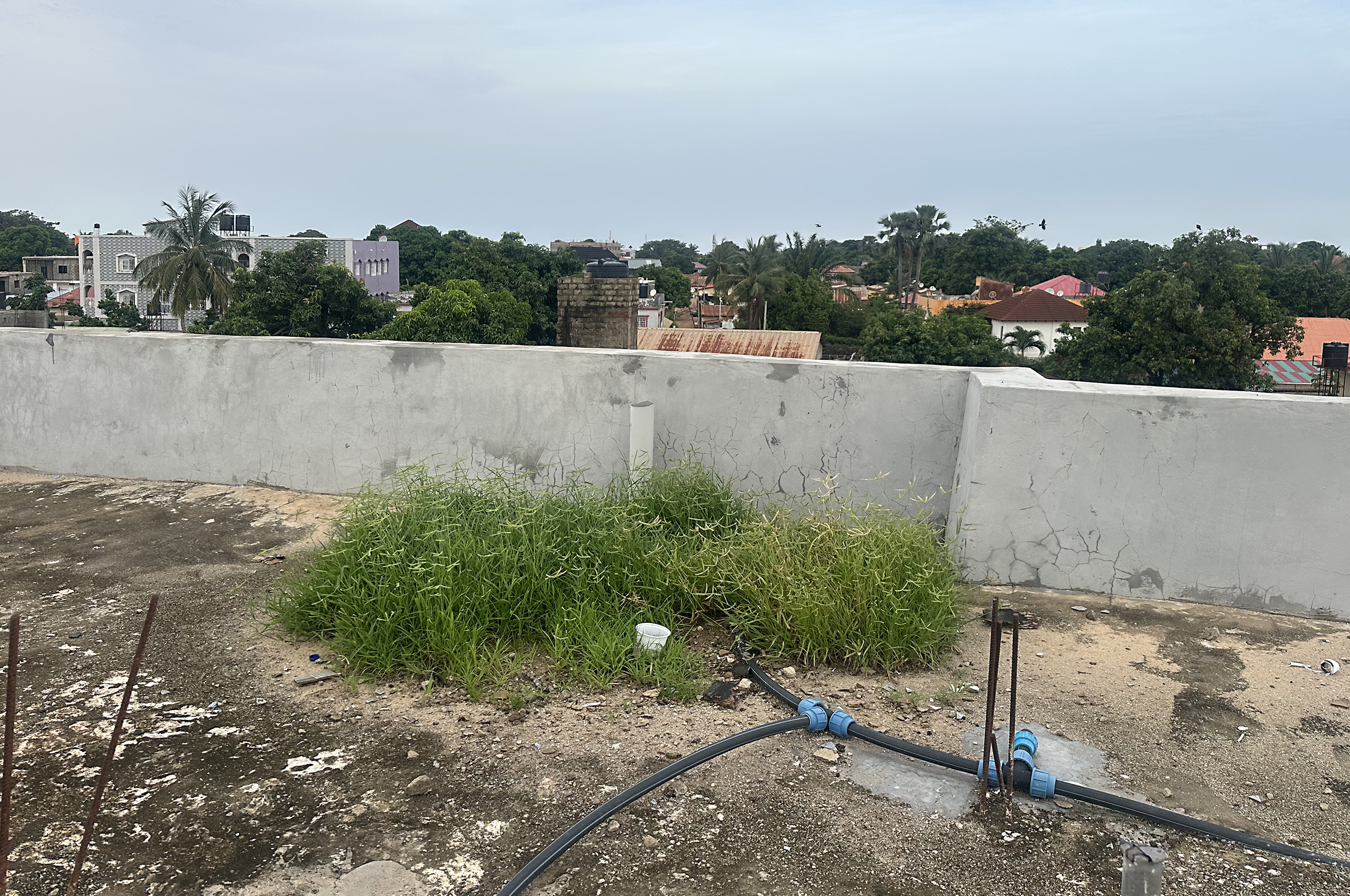
after a while, i called her, but she didn't come. it had started to rain, so i went looking for her. she was somewhere nearby, sniffing intently at something. suddenly, the rain became heavier, and i hurried back towards the stairwell door.
and that's when it happened.
i tripped over a concrete negative form and half fell onto a bundle of protruding iron rods. for a moment, i was frightened by what might happen as the iron rods came closer to my body. luckily, i got away with only a few scrapes, pain in my knee and wrist, and pain beneath my left shoulder blade where i landed on one of the iron rods.
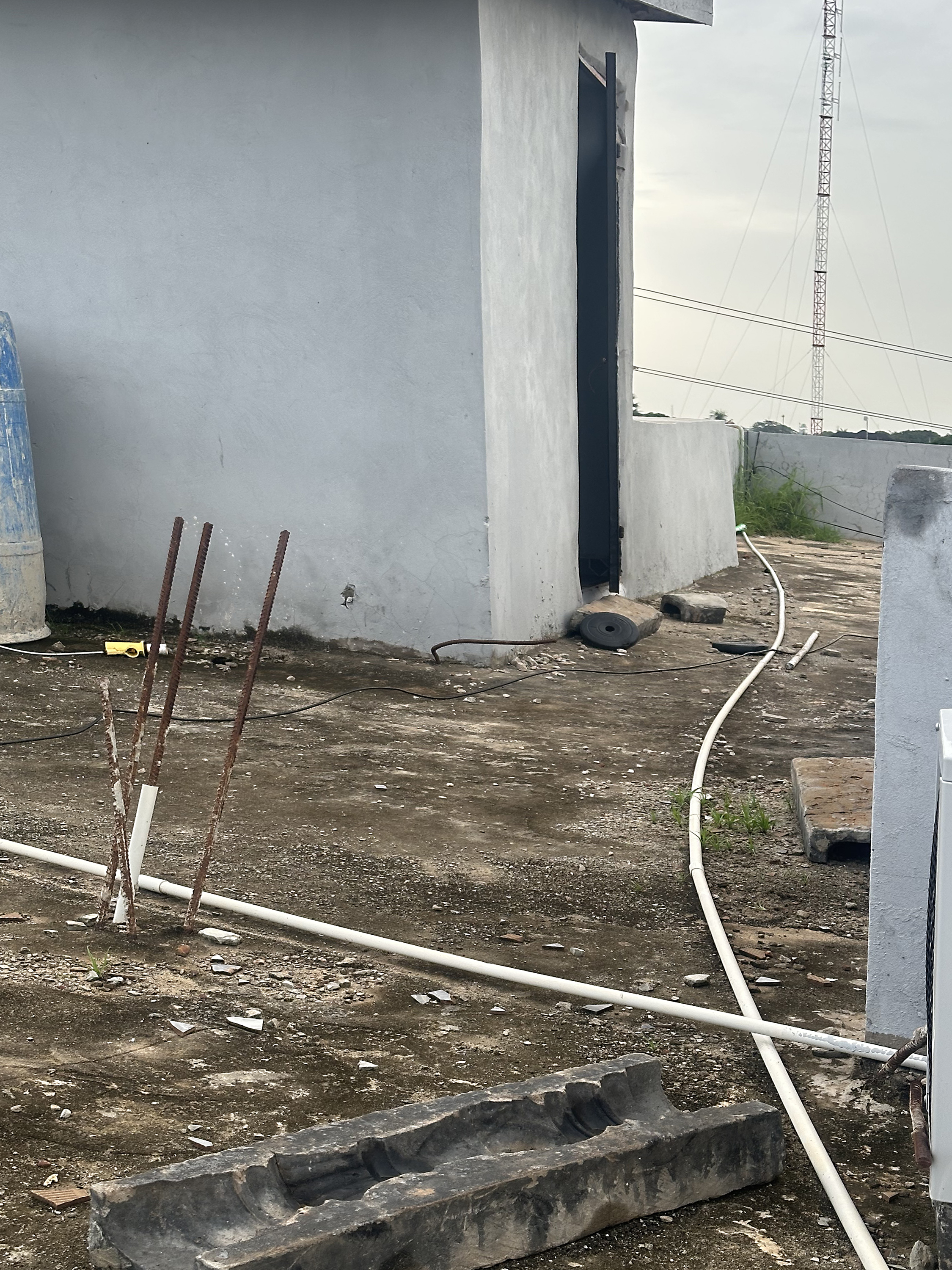
it reminded me of the time i fell down the stairs in Tintinto and, again, nothing serious happened — i hope. there are these moments when the body suddenly loses control of a situation that seemed completely ordinary only seconds before.
now i'm limping around because i wasn't paying enough attention. there is nothing to do about it except give my body time to heal. and healing, i know, is an active process. the body takes over, slowly repairing what has been damaged, while i can only wait and allow it to do its work.
Thursday, 27
this morning i came across new, more detailed photographs of Mars. they made me think about how much research is being devoted to this distant planet and about the plans to send humans there one day.
i've always loved looking at stars. since i was young, i could spend time looking into the night sky and wondering about the immensity of it. their distance was part of that fascination. i never felt a desire to bring them closer, to reach them, or to make them accessible to human life.
even the Moon seems extraordinarily far away to me.
i understand that satellites are useful and have become part of the infrastructure of our lives. they make communication, navigation, weather observation and other things possible. i can understand sending something into space when it serves a purpose of life on Earth.
but i find it much harder to understand why we should invest such enormous effort in overcoming the hostile conditions of mars in order to make it possible for humans to live there.
Mars is not a second Earth waiting for us. it is a cold, dry planet with a very thin atmosphere.
we already have a planet that provides all conditions we need. and yet we have not managed to organise human life on it in a way that gives everyone the possibility of living with dignity.
there are people who do not have clean drinking water, adequate food, secure housing or access to basic healthcare. there are people whose lives are determined by poverty from the moment they are born. there are communities already suffering from rising temperatures, droughts, floods, fires and other consequences of a changing climate.
and these are not problems for which we lack knowledge. we know much about their causes, and we know many of the measures that could improve the situation. what we seem to lack is the willingness to make the economic and political changes necessary to put them into practice.
the question, then, is where we direct our intelligence, our ambition and our imagination.
human beings are remarkably inventive when they want to achieve something. we can send machines hundreds of millions of kilometres through space and land them precisely on another planet, but we seem less prepared to imagine equally ambitious changes to the economic structures that prevent billions of people from living well on the planet where life is already possible.
Wednesday, 26
ignorance as strategy
there is another kind of not wanting to know that interests me. and it is not stupidity.
the person may understand perfectly well what is happening. they see it, they hear it, perhaps even know what it means. but something in them turns away.
they do not look any further. they do not want to hear more. they do not want what they have come to know to enter their own reality.
there is often a practical reason for this withdrawel. we cannot respond to everything we encounter, we become tired. we feel helpless.
turning away is therefore not necessarily an act of cruelty. but even when there is a reason for it, the fact remains: we have seen what we did not want to see..
that makes ignorance different from stupidity. somewhere inside, we have already registered what we are trying not to know.
we turn away partly because we understand that if we keep looking, the reality in front of us might begin to demand something from us. it might disturb the continuity of our lives. it might ask us to change something, to respond, to take a position, to help, to support. or, we simply do not want to experience what we are seeing. it may be painful and frightening. we would rather keep it at distance, not because we do not, but because we do understand.
so we look away.
not always consciously, not always deliberately, sometimes almost automatially.
but the effect is the same: for a moment, we make the world easier to live in by narrowing what we allow ourselves to see.
perhaps this is where the comfort zone begins.
not necessarily in comfort, but in the decision to protect the life we already have from realities that might disturb it.
as long as i keep walking, i can preserve the illusion that the encounter has nothing to do with me. as long as i do not ask questions, i do not discover what i might be expected to do — namely, to look closer and see the full picture.
thus leaving this comfort zone does not begin with solving a problem or changing a situation.
it begins earlier. with remaining present for a moment longer. with allowing myself to know what i have seen. with being able to say no without pretending that there was nothing to say no to. with accepting that i cannot respond to everything, without turning that limitation into a reason not to see what i have seen, but rather to remain aware of having perceived something that does not correspond to my idealised imaginations of how things should be.
so the difficulty is not that we ignore sometimes, but what happens when turning away becomes a habit — when we begin to protect the continuity of our own lives by systematically withdrawing our attention from whatever might disturb it.
ignorance begins precisely at the moment when we decide that what we have seen must no longer concern us, when we believe that not acting can erase the encounter.
Monday, 24
stupidity as strategy
we talked about stupidity, stupid people.
i suggested that this could have begun as a deliberate performance. people who at some point discover that not knowing can be advantageous. a strategy.
if someone acts as though they do not understand, others may explain things, make decisions, solve problems, or take over entirely. by presenting themselves as incapable, they are less likely to be given difficult tasks or held accountable for their outcomes. incompentence becomes a form of protection: as long as they seem unable to manage, someone else is expected to manage for them.
perhaps the strategy begins with a simple calculation: do not learn more than necessary, do not ask questions that create obligations, and do not become so capable that people begin to rely on you. competence attracts expectations, and expectations bring responsibility.
there is also a psychological comfort in not knowing. knowledge takes away the possibility of innocence. ignorance can preserve a kind of plausible innocence, whereas comprehension makes it harder to escape. once you recognise what is happening, you are expected to respond; once you know how to act, you could be blamed for not acting. ignorance can therefore serve not only as a limitation but also as a shield, allowing to avoid responsibility.
over time, someone who repeatedly follows the strategy and consequently avoids learning, curiosity, and independent judgement may genuinely become less capable. what began as feigned helplessness can develop into real awkwardness.
i distinguish this from people who simply have limited abiliites and knowledge. my theory concerns people who insist on remaining stupid, even when they have opportunities to understand.
arguing with such people can be frustrating: you may think you are making them understand, while they have an entirely different interest: not understanding it.
Sunday, 23
life is slipping away. i feel it when i go dancing. there something absurd about dancing at my age: the body moving, responding to music, wanting to be part of the rhythm, while i am aware that the time left to me is becoming smaller. i become a stranger among the young, surrounded by people that seem to belong naturally to the future.
and yet — i am still alive.
perhaps this is what makes it emotionally difficult.
i am not looking back from a place where life has already ended. i am here, still curious, still making things, still falling in love with ideas, still wanting to experience something i have not experienced before.
i try to look ahead while my past is growing into a gigantic monument behind me. more and more my life has beome something that already happened. something i can visit but cannot change.
and the future? it is short. there is no way around that fact. what a devasting verdict.
for most of my life, the future was an open space. even when i didn't know what would happen, there was always the feeling that there would be time for something else, another place, another encounter, another work, another beginning. now the horizon has become visible.
perhaps this is why living only from day to day begins to feel inevitable. not in the sense of giving up on the future, but because the present has acquired a different weight. a day is no longer simply one day among thousands still waiting to come. it is a piece of life itself — limited and unrepeatable.
still, i dance among the young, even as i feel my distance from them. i dance with the knowledge that time is taking me away. the music enters my body, my body answers.
for this time, i am not standing outside life, measuring what remains. i am inside it, moving with it.
the dance does not defeat death. it does something more honest: it gives mortality a body, a rhythm, a present tense. every moment is temporary, and that is precisely why it matters. the music ends, the body tires, the future remains short — but while the music is playing, i am not merely waiting for life to pass. i am participating in its passing.
Sunday, 16
when i am alone, my sense of being a particular person becomes blurred. my thoughts seem to detach themselves from my own biography. i think about people, relationships, society, art, life etc. and my thoughts become more general. the "I" is still there, but it is no longer the focus. it dissolves into the space or the surroundings.
as soon as another person appears, i become myself again.
this does not happen because i compare myself with the other person. i am not judging myself based on them. it is something more fundamental. their presence makes my own presence palpable.
this makes me think differently about solitude. we often speak of being alone as an opportunity to "find oneself" or to "have time for oneself". but perhaps solitude can have the opposite effect. without another person, there is less need for the individual self to assert itself. one can turn away from the particular and towards the universal. the self recedes into background.
in this sense, solitude leads us away from the experience of ourselves as individuals. in the presence of another, the self becomes more clearly located.
this means that relation does not merely connect already existing individuals. relation makes individuality tangible.
the distinction between relation and comparison seems crucial to me.
in comparison the other person serves as a measure: i discover myself by seeing how i differ from them. relation does not require this. the other person does not have to tell me who i am. they simply have to be there.
their presence changes the field of perception.
difference does not necessarily have to be overcome in order for connection to occur. we can remain distinct while being connected. the other does not have to become a mirror, a comparison or a definition of me. they can remain fully other, while their presence allows me to perceive myself more clearly.
this makes individuality and relation seem less like opposites. individuality is not something that exists entirely before relation. relation is one of the conditions through which individuality becomes visible.
i find this quite beautiful: when i am alone, i can feel less unique than when i am with another person, where i become special.
the self is something that comes into focus through relation.
Saturday, 8
following up on my post yesterday, i would like to point out that while ideas may work perfectly in theory, their practical implementation often turns out quite differently. mistakes happen; they are part of life. what i find particularly exciting, however, is what emerges unexpectedly in the process. things may shift, resist, or take an entirely different direction from what was initially imagined. sometimes these deviations reveal possibilities that could not have been anticipated before. the unexpected becomes not a failure of implementation, but part of what making itself brings into view.
perhaps this is one of the fundamental differences between thinking about something and actually making it. in imagination, there is a certain freedom from resistance. materials do not have their own weight, surfaces do not behave unexpectedly, colours do not change according to their own logic, and time does not interfere. an idea can remain coherent, because nothing has challenged it yet.
of course, when imagining a work its conditions are taken in account: the material, dimensions, the technique, the limitations and possibilities they offer. the plan may be quite precise, and its premises are carefully considered. yet, there are always aspects that remain beyond anticipation, and these only become apparent in the process of making. when they do, they may initially appear as mistakes or failures in relation to what was intended. but this does not necessarily mean that the idea has failed. on the contrary, the unexpected may be precisely what opens the work to something that was not contained in the original idea.
the resistance of reality may be precisely what allows something new to emerge. a material may suggest a different solution; a mistake may produce a more interesting result; a limitation may force a decision that would otherwise never have been made. what initially appears to be a deviation can become part of the work's acutal logic.
that is why making remains indispensable, even when an idea seems perfectly clear. if everything could be anticipated, there would perhaps be little reason to make it at all. the work would merely confirm what was already known. making introduces another kind of knowledge, one that is not available entirely through reflection or imagination. it tests the idea against the world, and in doing so changes the idea itself.
this brings me to the notion of control in art. decisions are made, intention matters. but complete control would leave little room for discorvery. perhaps the artist's task is not to eleminate the unexpected, but recognise when something unexpected deserves to be followed.
the mistake, then, is not necessarily something to correct. sometimes it is the moment when the work begins to speak back.
Friday, 7
i haven't produced a tremendous amount in my life and i often wonder why artists are judged by their productivity, as if they were machines churning out works. the number of works produced seems to have become a kind of measure of seriousness, relevance, even success. yet artistic work does not necessarily follow such a logic. some ideas take their time to develop; some remain dormant for a while before finding their form. there are periods when almost nothing visible is produced, although something may be shifting beneath the surface.
perhaps what matters is not how much an artist produces, but what kind of attention is invested in the work, and what remains once the work exists. a single work can occupy years of thought, while a large body of work can sometimes feel like an accumulation rather than a necessity. i have never been particularly interested in producing for the sake of production. my relatively small number of works says maybe less about my capacity than about the way i have understood being an artist: not as a continuous manufacturing process, but as a way of living, observing, thinking, and, as a matter of fact, self-evidently giving form to what, in the process, reveals itself as essential.
giving form, however, is not merely an act of implementation. upon closer reflection, the process also raises questions that do not arise in pure theory. what emerges through making is not necessarily something that could have been known before through thought alone. in this sense, the act of making does not simply give form to what already exists in the imagination; it also brings into view what was not imagined before.
Monday, 3 August
on Friday, i went to the Senegambia Craft Market to look for something for the Work of the Month. until now, almost all of the works i have featured have come from the Griffelkunst collection. i began to wonder why i had never chosen a work by a Gambian artist. since i was already in town, it seemed like the right moment to see what i might find.
the market has only one dealer selling paintings. as i looked through them, i asked whether he could tell me anything about the artists. his answer was simply that he had bought the works. i then asked whether he knew Anne from Topshop and whether she might also buy from him. at first, he dismissed the question, saying he didn't know her. then he corrected himself: she had her business, and he had his. that was all.
when he raised his prices — presumably after realising that i was genuinely interested — i decided not to buy anything.
on the first floor of the Tropic Centre there is also a gallery representing a single artist, who, if i understand correctly, is also the gallery owner. there, too, i found nothing that felt right.
on the way home, i found myself wondering why, apart from Isha Fofana, i have never really come to know any Gambian artists personally during all these years. it was a slightly frustrating thought, although not a surprising one. i have been aware of this absence for a long time. the truth is that i could have made more of an effort to seek people out, but i didn't. that is simply the reality.
a few years ago though, at one of the first openings at the KeyArt Gallery in Kanifing, i spoke with several artists. we exchanged contact details, but nothing ever developed from those conversations. not even with the gallery owner, who repeatedly promised to visit Tintinto. then he became a father, and life understandably took a different direction.
perhaps this says something about the art scene here, but it also says something about me. i have often expected encounters to emerge naturally or organically, through shared curiosity or coincidence, instead of actively creating the conditions for them. living and working in Tintinto has given me freedom, but it has also kept me at a certain distance. so, for now, Horst Jansssen's self-portrait will remain Work of the Month.
Friday, 31
Comprehension does not mean denying the outrageous, deducing the unprecedented from precendents, or explaining phenomena by such analogies and generalities that impact of reality and the shock no longer felt.(...) It means, rather, examining and consciously bearing the burden which our century has placed on us.
Hannah Arendt, The Origins of Totalitarianism
understanding doesn't mean to move closer to acceptance. it means perceiving the nature or quality of a thing, a situation or a person without collapsing into moral categories.
forgiveness, however, in my view, is not an intellectual consequence of understanding, but an emotional response tied to the recognition of wrongdoing and responsibility.
understanding is the willingness to face reality without looking away from what is difficult, disturbing, or contradictory. the truth is that we often seek the comfort of immediate conclusions.
Arendt reminds us that reality deserves our full attention. she warns against explaining the unprecedented by reducing it to what we already know. understanding means allowing experience to surprise us, even when it unsettles our convictions. it asks us to remain open to aspects of reality that may not fit our expectations.
understanding, therefore, requires neither sympathy nor distance. it demands insight. it requires us to see what is actually there.
perhaps this is why understanding is so demanding. it offers no relief. it does not simplify the world, nor does it resolve its contradictions. instead, it asks us to remain with the reality long enough for thought to begin.
judgment has its place. so does forgiveness. but neither should precede the difficult task of seeing the world as it is.
Thursday, 30
objects persist long after the incident that gave them meaning. pictures remain on walls, books on shelves, letters in drawers. there presence suggests continuity, yet it may equally testify to the gradual fading of attention.
a photograph can endure while interest in its subject silently disappears. it becomes part of a room, contributing to its atmosphere and perhaps even to the identity of the person displaying it.
what once was a testament to an encounter gradually transforms into an object in its own right. representation begins to replace relationship. detached from its original context, an image becomes available for new purposes, sometimes serving interests that bear little relation to those from which it emerged. it may continue to evoke authencity, intimicy, or shared history, while the living connection that once sustained those meanings has long dissolved.
this transformation is subtle because nothing visible appears to change. the picture remains in the same place, preserving the appearance of continuity. yet the image itself cannot guarantee that the relationship it represents still exists. presence can conceal absence. what survives is not necessarily the bond but its representation.
respecting a work therefore means more than acknowleding its author; it also means resisting the temptation to absorb it completely in one's own narrative. every work carries traces of another person's intentions, experiences, and autonomy. to leave room for that otherness is a form of respect. without it, representation risks becoming possession, and what once testified to a genuine encounter is reduced to a decorative object, valued less for the relationship it embodies than for the role it plays in someone else's story.
Wednesday, 29
what i wrote yesterday, actually happens to me as well. i enter rooms where i see pictures of myself — often photographs — hanging on walls or pinned somewhere, as if they were simply part of the decoration surrounding the one who keeps them. the image remains present, while the person behind it often seems strangely absent.
what unsettles me is not the existence of the photographs themselves, but the feeling that do not necessarily testify a real interest in me. sometimes i sense that the image is easier to keep than the relationship. a photograph can be displayed without requiring curiosity, attention or the effort of mutual exchange.
and there is another pattern i keep noticing: these people often seem to expect me to take the first step, to approach them, to ask questions, to create connection. as my picture on their walls did already enough. it leaves me with the uncomfortable feeling being visible and invisible at the same time — present as an image, but not encountered as a person.
perhaps this is why certain forms of recognition feel so ambigious. to be remembered is not the same as to be seen. a photograph may survive for decades, while genuine interest reveals itself only in the small gestures that say: i want to know who you are now, not only who you once were when this pictue was taken.
i think that these images have, over time, been reduced to mere objects. they no longer carry any real connection to the person in the photograph - me - but simply function as background decoration, quietly lending something to the identity of the person displaying them. in that sense, they are adorning themselves with me rather than engaging with me. that is certainly not what i understand art to be.
Tuesday, 28
when i return to older diary entries, i am sometimes surprised by how much they reveal. i find thoughts, emotions, experiences and graphics laid bare in ways i had not noticed while i was writing. it is only afterwards that i recognise how intimate some passages are.
i have come to think that this is inherent in the way i write. my diary is not simply a record of events, nor is it merely a place to unburden myself. it is where my inner experience is tested against language. i rarely begin with complete clarity. more often, i write in order to discover what i actually think or feel. yet this process has an unexpected consequence: the more faithfully i follow my thoughts, the more i reveal. intimacy is not always a conscious choice. sometimes it emerges simply because language demands honesty if it is to lead anywhere at all.
that honesty also carries a risk. the people who inhabit my life inevitably inhabit my writing. sometimes i mention them directly; sometimes they appear only indirectly through my own reactions. i never write with the intention of exposing or judging anyone, yet i know that someone may feel hurt or disappointed by seeing themselves reflected in my words. often i realise this only after i have finished writing, when the private process of thinking has already become a public text.
perhaps i have always assumed that readers would approach these pages with empathy rather than judgment. not empathy in the sense of agreeing with me, but of recognising that a diary records a moment in the ongoing movement of a life, not a final verdict on people or events.
what i miss, however, is the reader stepping out from behind the anonymity. very few people respond directly. i would not mind criticism. an honest reaction would be a relief, because it would restore the human relationship between writer and reader. silence easily turns the reader into an invisible observer, while i continue exposing parts of myself.
fortunately, my diary is not only a place for conflict or pain. just as often i write about ideas that excite me, works of art that move me, conversations that linger, or small observations i simply want to share. yet even sharing beauty is an intimate act. to reveal what touches us is another way of revealing ourselves.
perhaps that is why i continue to write even though i miss feedback. not because i possess answers, but because writing allows experience to become thought, and thought to become something i can live with. in that sense, every entry is both a conversation with myself and an invitation to whoever is willing to enter it with curiosity rather than certainty.
Monday, 27
today i watched a video where Tilda Swinton is reading her poem.
my first impulse was to share the entire text here. it is simple, direct, and, to me, inspiring. but after talking to chatgpt, i learned that because it is a recent work, i should not republish it in full without permission. copyright protects the complete text, even when the intention is simply to share something beautiful.
so instead i am sharing only the lines that stayed with me most.
Notes for Radical Living
make friends with chaos — hold a calm mind — let things shake
forgive human frailty
(...)
defy unkindness
(...)
listen to the quiet — respect the young
seek growth — trust in change — treasure learning
(...)
hold faith in miracles — look beyond the binary
be wary about the doubtless
honour the bright-headed
grow plants — attend to the weather
(...)
cherish language — celebrate silence
dance daily
bless the handmade
(...)
sing into pain
challenge assumptions — follow the wind
look upwards
swoon under clouds
feel your courage
(...)
be trustworthy — take care of yourself
believe in goodness
head for the light
the contradictions are productive tensions. none of these ideas cancel out another. it is about holding opposites together whithout rushing to resolve them.
over the years i have become less interested in certainty than in the space where contradictions coexist. chaos and calm. light and shadow. language and silence.
maybe that is what radical living means: not simplifying life, but becoming spacious enough to live this complexity. head for the light i don't read as optimism that ignores darkness. rather, it is a decision about direction. we cannot chose everything that happens to us, but we can choose where we turn our attention.
Sunday, 26
and again, no water. this time, however, the pump was genuinely broken. i believe.
the technician had brought a new one and took the old one for inspection.
the replacement pump was installed too late in the day to be tested. the following morning, the controller displayed an error message: something was obstructing the pump. we pulled it back up and found it completely clogged with sand.
the waterpipe had been too long that the pump hand been installed to deep — exactly what i had suspected and mentioned to the technician beforehand. as a matter of fact, we measured the point where the water level in the well begins today. we shortened the water pipe by three meters.
as there hasn't been any sun, we are managing with the rainwater we have collected.
Friday, 24
in an email, someone addressed me as Mara instead of Maren. it was only a small mistake, yet i noticed that i liked it. what a nice name, i thought. Mara sounded lighter, somehow taller, almost as if it lifted me a little. it seemed to carry fewer expectations.
for moment i experienced myself from a different angle, not changed, but somehow freer.
it reminded me of why i once chose to become Mimi. changing name was not about hiding who i was. it was about creating a little distance form the person i had been expected to be, and allowing myself to become someone who felt more like myself.
Wednesday, 22
a sentence from a recent conversation with someone close to me has stayed with me.
i was listing the things i still had to do. that person answered that he only does what he wants to do. if something feels like an obligation he doesn't want to do, he simply doesn't do it. there is no i have to do this or that. and then, he added, there is no point about complaining afterwards when you just do what you want to do.
at first i wanted to argue. after all, life is full of responsibilities i don't like to do. many things simply have to be done. but the more i thought about it, the more i realised that there is something worth considering in his perspective.
perhaps the real problem begins when we repeatedly expect another person to share our own sense of obligation.
i often find myself asking, reminding, encouraging, hoping that this time we will do something together. when it doesn't happen, disappointment follows almost automatically. the disappointment is real, but it is partly created by my own expectation.
he rarely asks anything of me in that way. he seems to accept that whatever i do, i do because i have chosen it. he leaves me with a question rather than an answer.
what would change if i approached things in the same spirit? not withdrawing, not becoming indifferent, but accepting that cooperation cannot be negotiated into existence. it either grows from a shared wish or it does not.
perhaps there is a certain freedom in stopping the constant invitation. not as a punishment, and not as resignation, but as a way of respecting the other's freedom as much as my own.
the real shift is not only about accepting that another person chooses differently. it is also about recognising how much my own unrest comes from measuring myself against that difference.
when i see someone sitting quietly while i feel overwhelmed by everything that needs to be done, i may not only be frustrated with that person. perhaps i am also confronted with a freedom i do not allow myself. instead of restricting myself, i want to recover the freedom to choose my own actions without making my peace depend on whether someone else chooses the same.
if i stop asking the other person to share my sense of responsibility, i may also become freer to choose my own way of carrying it. not because the obligations disappear, but because i recognise them as my own choices.
Tuesday, 21
music found its way back into my routine.
the gym in Tujereng has appeared in these notes before, perhaps more than once. it was a great place. we started training there at the beginning of 2022 and were the first as it opened that very year. the equipment was used but perfectly adequate. John, a qualified trainer whose trophies were displayed on the counter at the entrance, had built it up himself. we had some good conversations, and one day he visited the House of Culture Tintinto.
at the time, the structure on the roof terrace hadn't yet been plastered or painted. looking at it, he asked "why isn't your building finished?"
the question surprised me. until then, it had never occurred to me that it wasn't completed. since we had been living there, it had simply been finished — in my eyes.
at the beginning of this year, John decided to move to Spain. he no longer felt comfortable in Gambia, and the gym closed. i was genuinely sorry to see it go.
so we returned to the gym in Tanje where we had trained before, from 2020 onwards. the room is about a quarter of the size. the machines are awkward to use, some even feel unsafe. AND there is no music.
i train much better with music. but headphones are no longer an option for me. i no more like the idea of retreating into a private acoustic world while sharing a room with other people.
during my recent stay in Kololi, i started listening to Amapiano, African Beats and House mixes through my mini bluetooth speaker. chilled though rhythmic, quietly uplifting — much of it ai generated, but it doesn't matter. if i enjoy listening to it, why should its origin diminish the experience?
now, whenever i open the laptop, music starts playing. most of the time instrumental, without lyrics — which i find a relief. sometimes it reminds me of the electronic music we used to produce with MALOLA.
music has always been important to me. i never stopped listening whenever i had the opportunity — at concerts, in bars, at the gym or whenever someone decided to let others listen through their device. what i had forgotten was how much i enjoy letting it play myself.
Friday, 17
i recently realised that i had started looking at the House of Culture Tintinto almost exclusively through imagined judgements from outside. in doing so, i was losing sight of the perspective from which the project had emerged.
looking through other people's eyes can be illuminating. it allows us to discover things we would otherwise overlook. as an artist, i have always valued this. i enjoy seeing the world from different perspectives. i rarely believe there is only one way of looking at something.
yet there is another side to this openness.
sometimes another person's perspective becomes so dominant that it begins to displace my own. instead of enriching my understanding, it quietly replaces it. i begin to see my work less through the experience of making it than through the possibility of how it might be judged. i suspect this is one of the difficulties every artist encounters. how can we remain open to other ways of seeing without allowing them to erase the vision from which the work emerged?
this question recently resurfaced in relation to the House of Culture Tintinto.
the name began as a working title. and somehow it stayed. then i found myself wondering whether it promised too much. did it sound as though i were claiming to have established an institution? was the name larger than the reality?
for a while i seriously considered changing it to Tintinto House.
then i realised that these questions had less to do with the project itself than with the perspective from which i was looking at it. i had gradually exchanged my own view for an imagined external one.
the house of culture tintinto actually began with a concept. i imagined workshops, lectures, readings, artist residencies, and exchanges. friends believed in the idea and encouraged me., but institutional support i had hoped for never materialised. in the end i built it with my own means.
over the years, however, something else has happened. instead of trying to fulfill the expectations i had once attached to the project, i gradually began to pay attention to what was actually emerging. living there. with time, conversations, visitors, artworks, plants, animals, seasons, and the slow accumulation of experiences.
what changed was not the project but my understanding of it. today i think of it less as an institution than as an offering.
an offering is not validated by the number of people who accept it. it is made because someone believes it is worth making. it is an invitation rather than a claim. an invitation to visit, to think, to spend time, to disagree, to contribute, or simply observe.
so i will keep the name. not because i have stopped to listening to other perspectives, but because i have recovered my own. i understand Culture as something that belongs not only to museums. for me culture begins wherever people, ideas, histories and every day life meet. by that understanding the name still feels right.
Sunday, 12
it finally rained today after a long dry spell. a dark sky heralded the event.
this kind of weather gives me headache. the heat in the apartment at Palma Rima Road is unbearable. thinking seems almost impossible.
friday night we went to Domino's.
we knew the dj, but there were only some handful of people around what made the evening interesting in another way. communication happened at a distance, non verbally through dance moves. the sea breeze was mind blowing and wonderfully refreshing — a gentle wind that made the night feel light.
since yesterday however, the air has been completely stifling. it was standing without a move. finally the tension was released this afternoon by a short but massive thunderstorm. yet, despite the heavy downpour, the temperature has hardly changed - at least inside the rooms. the rain brought relief to the earth, but not to the heat.
Thursday, 9
@instagram updated
Tuesday, 7
Headstrong
some words leave behind a question even though their meaning has been explained. for me, headstrong is one of them.
at first, i understood it literally. a strong head — not in the physical sense, but in the mind. someone capable of holding a thought or following an idea firmly, someone whose judgment does not collapse under pressure. what else should a strong head suggest?
then i learned how the word is actually used. headstrong does not simply describe strength of mind. it carries a disapproval. it describes someone who is determined, but unwilling to listen, unwilling to reconsider, unwilling to be moved. the dictionary leaves little room for another reading.
what the dictionary cannot tell me is how the word came to mean that.
somewhere along the way, a strong head stopped being imagined as a vessel for thought and became an obstacle to it. strength came to imply resistance rather than clarity. the image remained the same, but its connotation shifted.
this is not unique to headstrong. we often distrust strength when it refuses to yield. yet yielding is not always wisdom, just as standing firm is not always pride. the line between conviction and stubbornness seems less like a difference in action than a difference in interpretation.
every virtue casts a shadow that language eventually learns to name. courage becomes recklessness when it outlives caution. confidence becomes arrogance when it forgets humility. patience becomes sluggishness when it waits too long. the qualities themselves do not disappear; they simply cross an invisible threshold where admiration turns into criticism.
Monday, 6
every family has its own moral vocabulary.
there are words that function as rewards or reprimands, quietly determing which qualities deserve approval and which require correction.
whenever my mother called me hartnäckig, i knew i had crossed a line. i had persisted beyond what was considered acceptable. i defended a position i was expected to abandon, or refused to back down simply because someone older had spoken.
if tenacity is consistently interpreted as defiance, the lesson extends far beyond learning not to argue. gradually, one learns to distrust one's own persistence — to let go of questions too quickly, to discard ideas before they have fully developed, and to mistake agreement for maturity. a quality that might one day become intellectual curiosity or resilience is experienced first as a character flaw.
looking back, i don't think i was forbidden to have opinions. rather, i learned that my opinions were welcome only insofar as they confirmed those of my parents. yielding was preferable to understanding, that harmony mattered more than conviction, and that accepting authority was a virtue in itself.
Der Geburtstag verlief harmonisch (The birthday went harmoniously) was another of my mother's recurring expressions. harmonisch did not simply describe the atmosphere. it described the successful preservation of a particular order. for my mother, harmonisch meant peaceful — but only on her terms. the definition was self evident and never open to discussion. if no one argued, if voices remained calm, if the family stayed together without visible conflict, the gathering had been harmonious.
for me however, the word carried a different meaning. what appeared harmonious from the outside felt unresolved from within.
the musical concept of harmony had been appropriated to describe power relations between human beings. a term that originally denotes the coexistence of distinct voices had to come to signify the absence of dissent. yet, harmony exists in different forms. musicians know that harmony depends precisely on different voices sounding together.
for all the public talk of antiautoritäre Erziehung throughout West Germany in the 1970s, our family had its own philosophy, and it rested on amenability disguised as harmony.
within that moral vocabulary, hartnäckig and harmonisch were oposing values. to be tenacious was to disturb peace. to be harmonious was to know when to abandon one's own stance. these words defined the boundaries of what could be said, who was permitted to disagree, and whose voice ultimately counted.
Sunday, 5
there wasn't as much sunshine as promised, but at least the tank filled up halfway. that was enough to cover our basic needs, such as washing ourselves and having water for the kitchen.
Saturday, 4
we had no running water for the past two days. that doesn't happen very often. we'd forgotten to check the water tank, which is absolutely essential during the rainy season when there isn't always enough sunshine to keep it topped up. since it hadn't rained for quite a while, we had started watering again, which used up more water than we realised. eventually, it had run completely dry.
fortunately, our neighbours are connected to the public electricity grid and can run their pump even at night. they kindly let us collect water from them — not for the plants, but at least for ourselves. when i went over with empty water bottles, the women working there were incredibly friendly. they brought me a chair to have a seat. of course i politely declined and helped them fill the bottles instead.
experiences like this make me aware how automatically i turn on the taps, especially just to wash my hands. even now, i keep turning them on out of habit, only to remember that there's no water.
the weather forecast says the sun should shine today, so hopefully the tank will refill. still i'm not entirely sure if there isn't something wrong with the pump or — even worse, with the borehole.
Wednesday, 1
somehow the conversation drifted to self portraits, and suddenly i remembered that this month's work would soon be due. my thoughts wandered through the Griffelkunst collection and to Horst Janssen, an artist who came from around the corner of my childhood.
my parents chose mostly works by local artists. that was their choice. they took what they understood, what reflected the landscape and culture they belonged to. Jansssen was part of that wider northern german art scene, but he always seemed like an outsider — even in their eyes.
brilliant, uncompromising, eccentric. a master draftsman whose intricate etchings and drawings often circled around himself. he created self portraits that are less about the appearance than about the unsettling business of existing. mortality, flowers, bones, animals, friends, wit and melancholy all occupy the same fragile space.
his work could be painfully honest, sometimes darkly humorous, and often carried the unmistakable shadow of the alcohol. which shaped much of his life.
i liked him precisely because of the nervous intensity of his pictures. one of my memories of his work is the illustration for Franz Josef Degenhard's Spiel nicht mit den Schmuddelkindern.
Janssen's self portraits are not acts of vanity but of scrutinity. they don't flatter.. they are attempts to catch something that keeps slipping away. not identity, but presence. the evidence of having been there.
Art Space Work of the Month
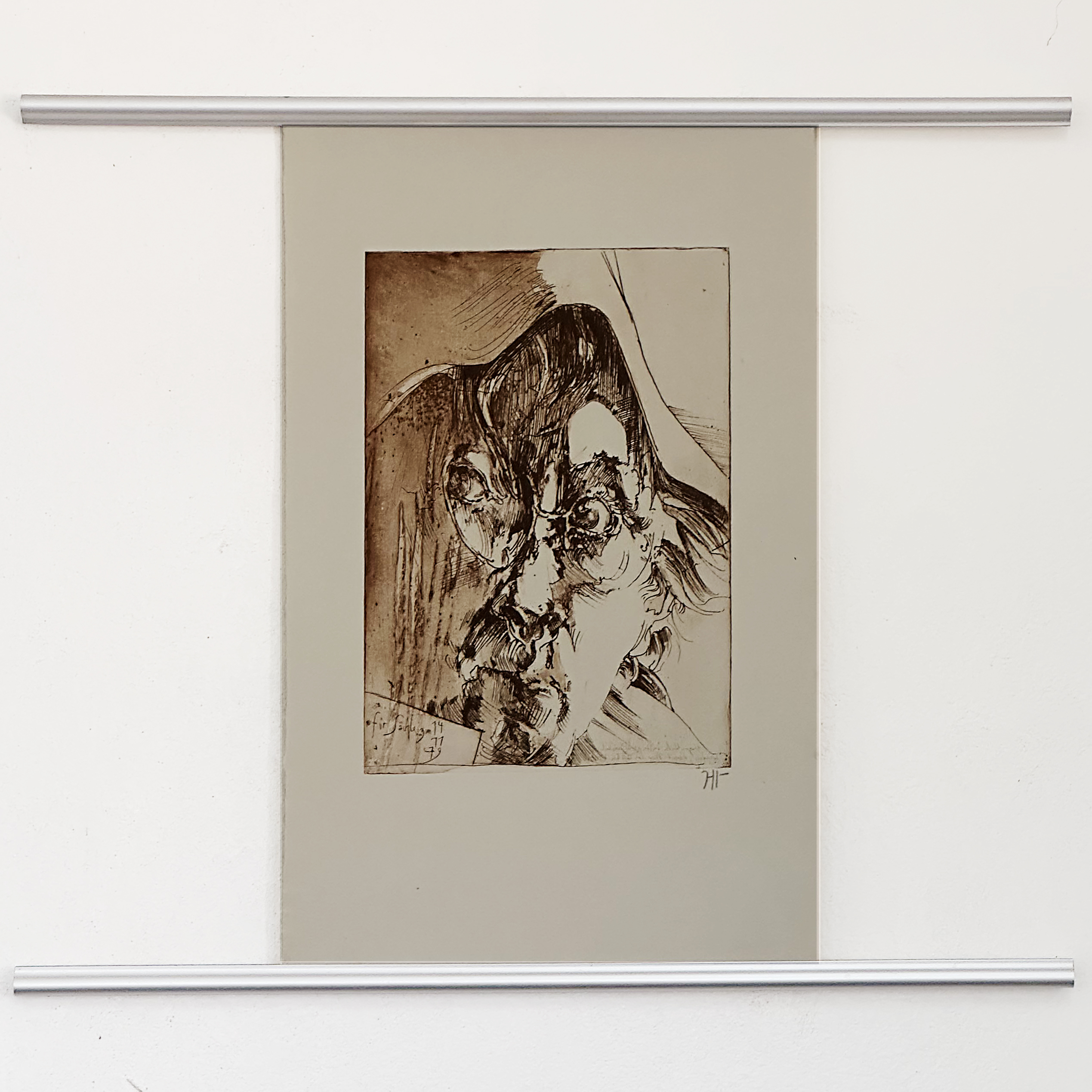
Horst Janssen (1929-95) Self Portrait "Für Sächle", etching, 1979, 31 x 50 cm