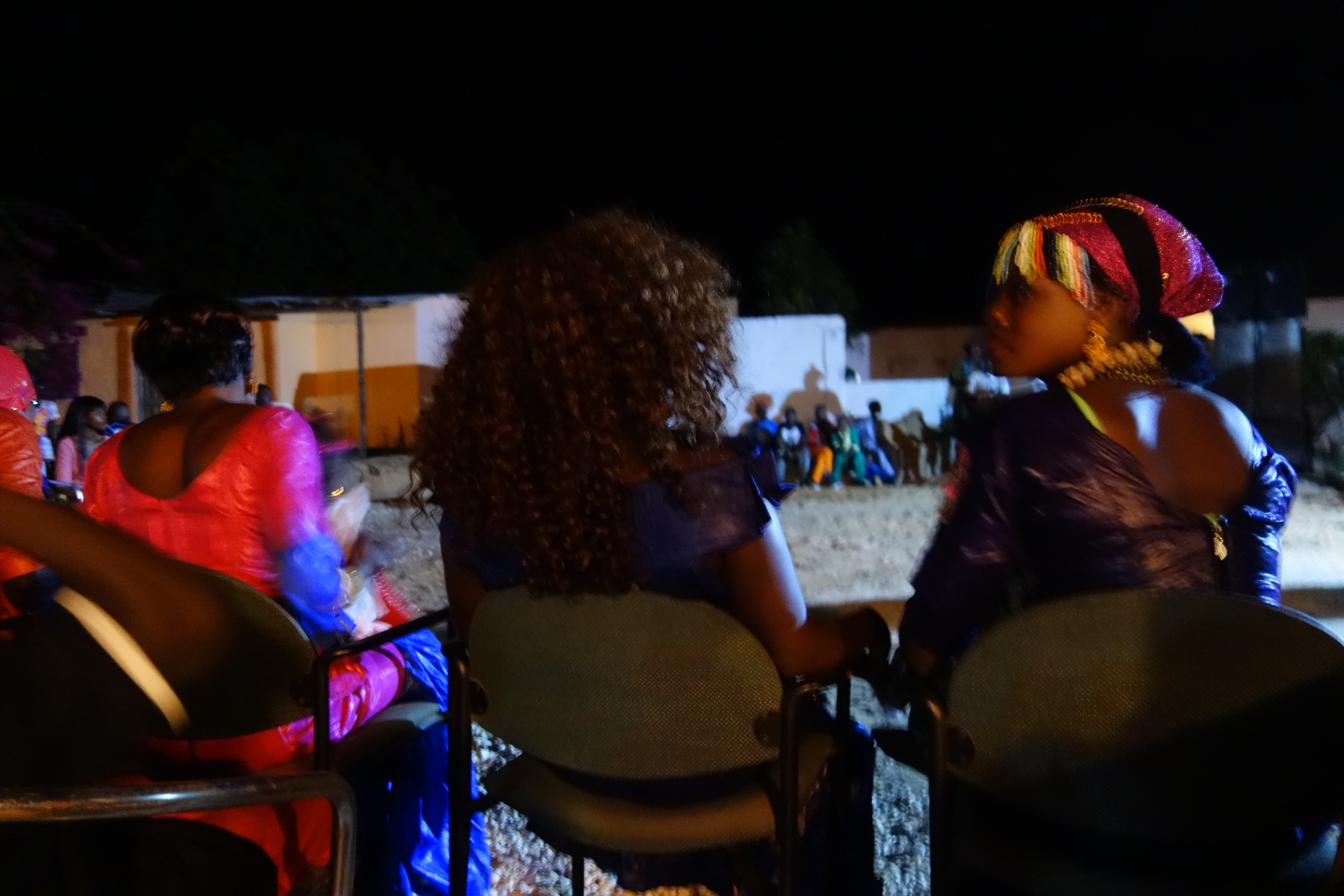
20160706 Dance competion at Plantation
Monday, 29
exactly ten years ago, on the night of july 28th to 29th, i arrived in The Gambia on a one-way flight.
i remember the long layover at Barcelona airport. i spent hours sitting outside in the open courtyard, enjoying the warm evening and thinking about the life that was about to begin. i was full of exitement. i had already bought the compound where i hoped to build the House of Culture Tintino. the dream was clear, even if i didn't know yet how it would all come together. but i was absolutely confindent that i would make it happen.
the first weeks were filled with discovery. life moved at an easy pace. i wandered around Brufut, getting to know the neighbourhood, and reguarly visited my shop in Sukuta later named Think Tank Tintinto, where my belongings were stored. every dusty road, every conversation, every chance encounter seemed to reveal another layer of the country.
in september i asked a friend to take me to the school in Tranquil, where she taught, so i could meet the headmistress. i was looking for contacts, especially a female architect who could help me turn my idea for Tintinto into something real. looking back that was one of those seemingly ordinary moments that quietly determined the course
of the years that followed.
what strikes me now is not that i had fewer plans back then
— i probably had the biggest plan of my life — i simply trusted that one step would lead to the next. nowadays, i catch myself measuring the day differently. there is always another task waiting. i become impatient more quickly than i used to, and often feel i should be working on something more important. dreams eventually become everyday life.
Friday, 26
what i've learned is that i can't use icloud as a cold archive. it is not designed to be a place where i can store files without keeping them avaivable to my devices. if i want a true cold archive, i'll need to look for a storage solution that's meant for long term, infrequently accessed data instead.
Thursday, 25
in the last days i found myself absorbed — and stilli am — in computer issues.
tuesday morning i received a message from my internet provider that my 150GB i bought some two weeks ago were used up. our maximum monthly usage is around 120GB. to find out what was going on, we drove to the customer service center in town, where i saw in black and white printed, that large amounts of data had been downloaded.
back at home i told the chatgtp about the problem and together we found out that icloud was synching my old desktop, which still existed in icloud — but only on icloud as i had thought.
some months ago i had realised that my desktop existed only in icloud. one day, when there was no internet connection, i found it completely empty. i was schocked, turned off the desktop download and installed a local desktop instead.
as my laptop is already full i left most of the material in icloud — the things i don't need often — and just added an alias on my local desktop to the documents and folders on the desktop on icloud. but it was not working like that. icloud is somehow trying to bring all the data back onto my laptop even though it hadn't been there before.
chatgtp advised me not to make any changes as long as the sychronising is still going on. so i am waiting and watching the gigabytes go down the data river.
my mind has been very occupied with this — first to understand what is happening, and then waiting that i can make changes to create space on the laptop.
Tuesday, 23
one thing is clear to me: i am not going to get any better. what matters is not measuring myself against who i once was or comparing today with yesterday. the comparison is no longer evident nor mandatory.
what remains is the possibility of experiencing life as consciously as possible in everything i do. to be present while working, writing, drawing, gardening, thinking, observing, speaking, eating, resting, doing yoga, going to the gym or shopping. to notice what is here rather
than what is missing. not improvement, but awareness. not progress, but attention. i inhabit what is whithout judging whether things are ameliorative or deteriorating.
Saturday, 20
from Instagram Littmann Kulturprojekte
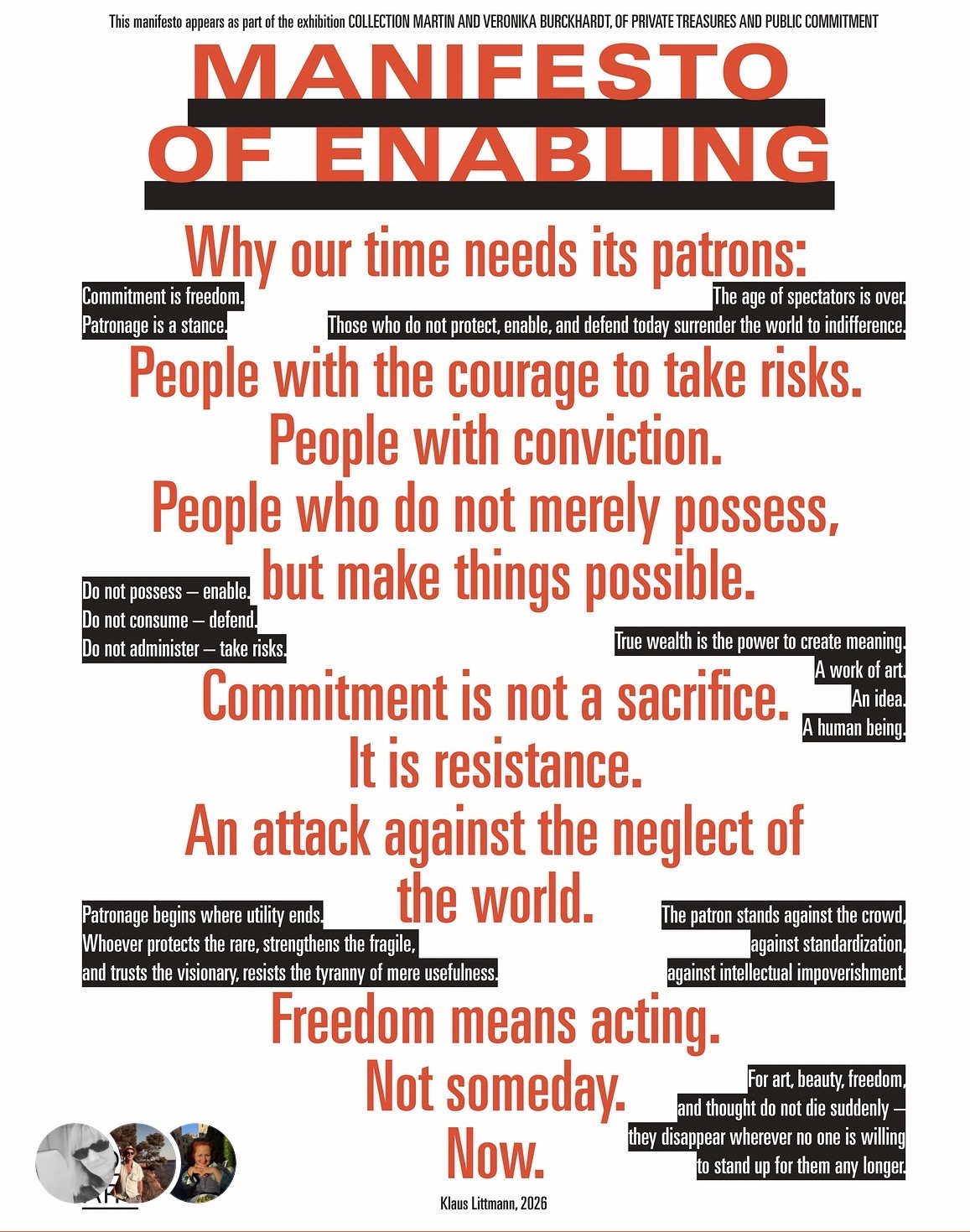
MANIFESTO OF ENABLING
Friday, 19
today is my birthday. last year i spent it at art basel. this year i've already been back in Gambia for two weeks.
when i see all the posts about the fair — who is there, what exhibitions are opening, and whom i might have met — i feel a slight sense of regret that i didn't stay longer. but then i remember how strongly i was drawn back here.
now i'm sitting in a restaurant in Tanje, drinking coffee. i had briefly considered going to the nearby gym, but in the end i decided that on my birthday i would rather sit here and enjoy the afternnoon.
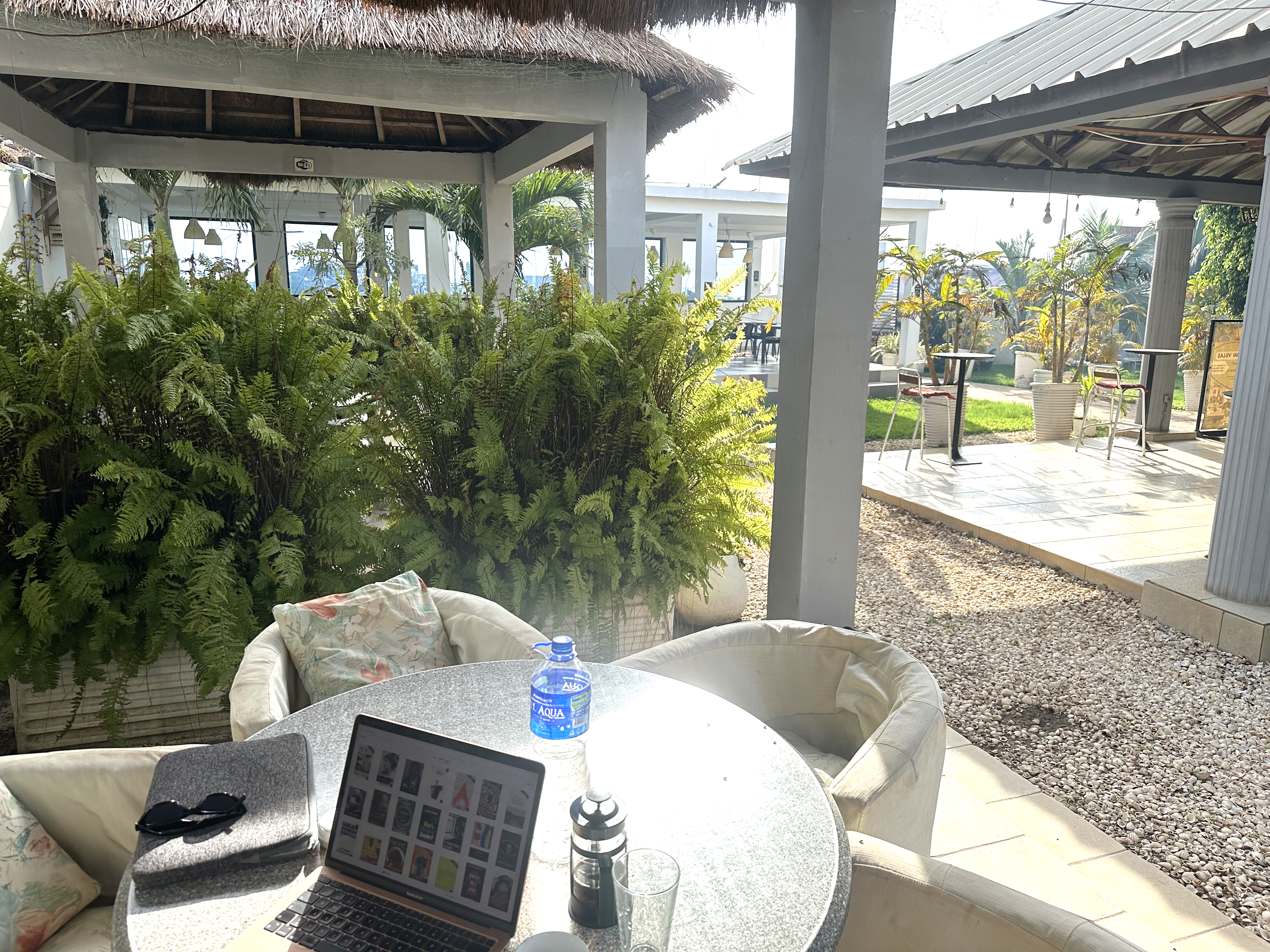
this morning brought the first proper rain since october. the unpaved roads are already dotted with puddles, and the long dry season suddenly feels over. months of sand and dust had settled on houses and plants. much of it was washed away today. the garden looks refreshed, and the air smells of rain.
am sitting in the Ocean Lounge, listening to music, slowly making my way through emails, and hoping to read a few pages before having a birthday dinner.
Wednesday, 17
The Post-Visibility Blues: On Venice 2026 and the Limits of Representation – Review
DakArtNews
Tuesday, 16
different scorecards
my mother used to say that women were more beautiful than men, and i never doubted that she meant it. yet it was men she amired. not only her husband, but men in general, and above all her father.
men,
in her view, achieved, acted, and carried responsibilty. women were beautiful, loved and spared certain burdens. they did not have to struggle for achievement. she was genuinely content with that arrangement. she did not envy men. on the contrary, she was glad not to be one of them.
the difficulty was not that she lived accordingly, but that she hoped i would do the same.
my life took another direction. i did not build the kind of family she considered the foundation of happiness. the life that attracted me was not the life she wished for me. she conformed to the existing system, while i devoted myself to values that could not easily be measured by social status or financial security. in her eyes, the important books were the ones that sold best; in mine, the ones that interested me.
looking back, i think we were using different scorecards. her scorecard valued stability, family, social respectability, and belonging. mine valued autonomy, exploration, creativity, and self discovery. neither scorecard is necessarily irrational. each reflects assumptions about what human life is for.
lately, however, i sometimes sense a change. since my father's death, i have the impression that my mother's certainty seems to have softened.
her view of what life can be seems to have widened. she appears more aware that lives different from her own may contain their own forms of meaning and fulfillment.
at my age, almost 68, i no longer expect complete understanding between generations. yet i find something comforting in that subtle shift. it suggests that even deeply held convictions can remain open to revision, and that the stories we tell ourselves about a well being are never entirely finished.
Sunday, 14
growing up in a family of doctors, i often felt that theorising was not particularly appreciated. what fascinated me, especially during my youth and later at art school, was the search for patterns, the development of ideas, and the attempt to explain connections beyond the immediately visible.
looking back, i understand that my family may have feared that i was drifting away from their reality. in a sense, they were right. through art, theory, and reflection, i gradually moved toward a different way of understanding the world.
at the time, i was not fully aware of this process. yet, on a deeper level, i sensed it. the desire to think beyond accepted explanations was not simply an intellectual exercise; it was part of finding my own identity.
today, i can appreciate both perspectives. my family's concern reflected a fear of losing a shared reality, while my own path required a certain distance in order to discover other ways of seeing and understanding. the separation was not an act of rejection but a movement toward something that felt necessary.
Saturday, 13
when i moved to gambia, i thought everything would be different, and it definitely felt that way. i was fascinated by the women in their long robes, the languages, the bright colours. the roads, the villages, the food — everything promised a completely different world. the compound walls, the cows wandering through town, the call to prayer drifting through the air. the climate changes how people move and how they spend their time.
i've since realised that life is not so different at its core. beneath these visible differences, people are much the same. they worry about their families, their health, their finances, and their future. they seek respect, companionship, and a sense of purpose. people fall in love, argue, dream, complain about politics, worry about getting older.
we notice difference first because it is visible. sameness requires more time. it reveals itself slowly, through conversations, routines, friendships and shared concerns. what seemed distant becomes ordinary and intimite.
Thursday, 11
recently, while showing a visitor the fenced area where the goats and chickens are kept, the person remarked that the Qur'an supports the idea of having such animals on the compound. as an urban person, i sometimes wonder whether goats and chickens are really the right way to present a cultural institution.
the Qur'an speaks positively about livestock and the many benefits they provide to human beings. goats, sheep, cattle, and camels are presented as gifts that offer food, clothing, and other forms of sustenance.
the remark i heard may arise from a broader understanding of Islamic culture rather than from a specific Qur'anic passage. in many rural societies, livestock symbolise stability, and a connection to the land. animals provide food, manure, income, and a degree of self-sufficiency. these practical benefits easily become associated with the idea of blessing.
animals are woven into everyday life. their presence reminds us that we are not separate from nature but part of it. perhaps that was what my vistior meant: that animals are not merely an addition to the compound, but a reminder of a way of life that remains connected to the natural world.
Wednesday, 10
sometimes it feels as if
i live in an oasis
though it is none
no deserts here
only gardens, trees, and birds
since october no rain has fallen
though
and plants live on water
drawn from the borehole
the place exudes a magic
as it feels set apart
from the rush of the world —
a small refuge where time slows down
and attention can return to simple things.
Tuesday, 9
my body is taking longer to adjust here, especially in the morning. which wasn't a problem in Venice. after arriving there, i was on the bus from Marghera to the island the very next day. the climate near the seaside seems to ask more of me. the humidity, the wind, and even though i've lived here for ten years now, i didn't grow up in Africa. Africa. South Africa is different, more like the European climate. West Africa is approaching its rainy season, or in some parts, it already has begun. the air is heavy with moisture.
on Sunday we drove to the beach. the car was hot, almost stifling, but once we reached the shore a chilly wind was blowing. some moments it even felt cold. since then, a slight soreness has lingered in my throat.
yes, we drive to the beach, even though the sea is only a short walk from the house. yet, between the house and the sea stretches a lagoon created by years of sand mining. it is too deep to cross. in Europe, people often asked why i did not simply swim across it. apart from a few children, nobody does. they say there are crocodiles in the lagoon. i doubt it, but i have never felt the need to challenge the story. some forms of knowledge are best accepted without argument. when you live somewhere, it seems wise to respect the experience and cautions of those who know the place far better than you do.
Monday, 8
back in The Gambia, back at House of Culture Tintinto, the place i longed for while i was away. during my travels i often found myself homesick, missing the slow rhythm of life here, the garden, the unfinished projects waiting for me, and the sense of continuity that only a familiar place can provide.
yet after only a few days of being back, another invitation arrived. Akka Project invited me to Layers in Venice, featuring the artist Dawit Adene. also in a few days, Art Basel is about to open its doors. A Song for Esther by Candice Breitz in Berlin. and suddenly i feel the pull again.
when i am travelling, attending exhibitions and meeting artists, i miss Gambia. i imagine the quiet mornings at Tintinto and the work that remains to be done. but when surrounded by the things i missed, my attention is drawn elsewhere again. the art world begins to move without me, and i feel its gravitational force.
for many years i thought this meant that i was somehow in the wrong place. wherever i happened to be, another place seemed more exciting, more important, more alive. there was always an opening, a biennale, a conversation, or an opportunity happening somewhere else.
but perhaps that is not really the problem.
perhaps the difficulty lies in wanting to belong fully to two different worlds at the same time. one world is built around movement: exhibitions, travel, encounters, and the constant circulation of ideas. the other is built around staying: cultivating a garden, completing long-term projects, maintaining a cultural space, and allowing things to grow slowly.
both worlds feel essential to me. one nourishes curiosity; the other provides grounding. one opens horizons; the other creates roots.
the challenge is not choosing between them. it is accepting that neither can ever be experienced completely. whenever i am in one world, i will inevitably miss something in the other.
so i am not in the wrong place at all, but exactly where i need to be, carrying the desire for another place with me. that longing is not a sign that something is missing, but simply the consequence of caring deeply about more than one home.
Wednesday, 3
i used to bring lots of gifts to express my joy to the people i met. after ten years of continuous travel, i have largely let go of that habit. in a way, it feels more relaxing.
buying gifts gradually became an obligation, and that sense of duty was often reflected in the gifts themselves. spontaneous gifts still happen, though. when i come across something that feels right for a particular person, i may bring it along.
eventually, i came to realise that the encounter itself is the gift, from both sides. when friends meet, each person brings their presence, attention, and willingness to engage. material gifts can be a lovely addition, of course, but they are secondary to what is actually shared between people.
if both people leave the meeting enriched, encouraged, or simply lighter than before, that may be gift enough. what each person then takes away is something they can continue to cultivate for themselves: a sense of appreciation, inspiration, or kindness. in that way, the gift does not end with the encounter but continues afterward in how we treat ourselves and others.
yesterday i traveled to Zurich, where i visited the Kunsthaus with a friend. despite the rainy weather, it was a wonderful day. we spent several hours looking at the exhibitions and talking, enjoying each other's company. it felt like a reminder of what i had been reflecting on: that the encounter itself can be a gift. we both returned home enriched by the experience, carrying with us not an object, but the memory of a day well spent together.
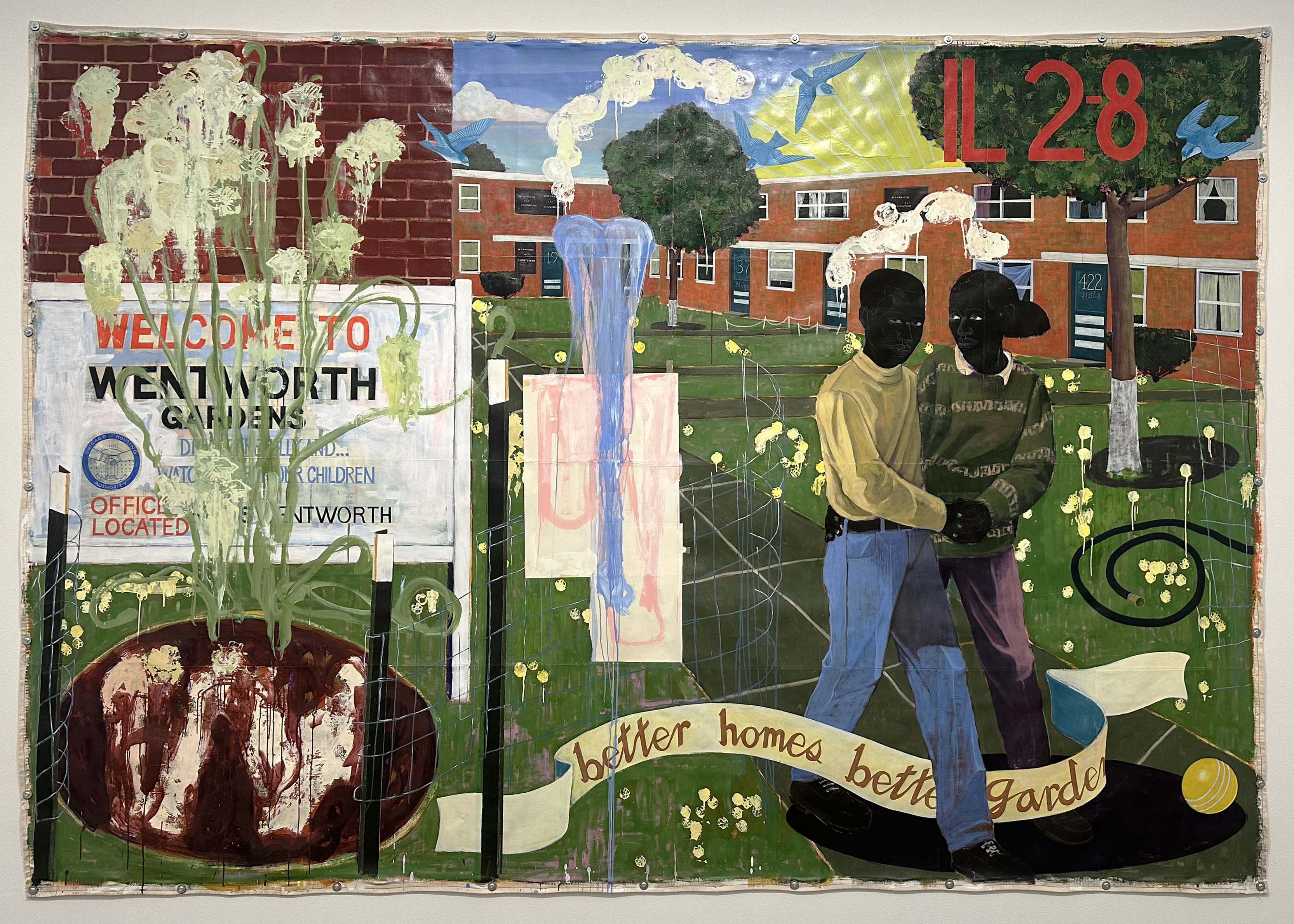
Kerry James Marshall (1955) Better Homes, Better Gardens
1994, acrylic and paint and paper on canvas. Kunsthaus Zürich 2026