Thursday, 30
it's this version of myself i find difficult to inhabit right now. not fully here, but not gone either —
suspended somewhere in between, like a door left afar that never quite opens or closes. i move through the day without entering it. things remain untouched. focus feels like a language i used to speak and have now forgotten.
my mind drifts without direction. it doesn't settle long enough
to take hold, yet it doesn't feel free either. it's a kind of restlessness without energy — a quiet agitation. i try to reach for something that might spark interest, but everything feels equally distant, equally flat. even the things i usally care about seem to have lost their surface, as if i can't connect with them anymore. there is no real sadness in this. just an absence.
i give up easily on small intentions. the day has a fragile, half-lived quality.
it is about the trip ahead. the traveling. the leaving. i ruminated about it a lot these past weeks. actually, i tried to keep up a positive attitude — looking foward to the change. part of me does look forward to — imagines a shift, a different rhythm and some challenges. going to the biennale as part of house of culture tintinto once carried a clear sense, almost a direction. there was a simple yes to it.
but something in that has weakened. i notice a hesitation now, and a doubt in whether i will really manage it well. the certainty i relied on is no longer as steady. as if leaving requires something i don't currently possess. there is also a certain loneliness. not the kind that comes from being alone, but something quieter — as if the inner alignment that held these things together has loosened.
for now, i accept this state of being in between.
it will pass, and perhaps it was necessary — a way of bringing me back to something more grounded.
Monday, 27
regarding the two websites i manage, i've never been particularly interested in search engine optimisation. perhaps in the early days, around 2000, when the internet still felt new, i liked the idea that people might come across my site. but that didn't last long. over time, the focus shifted towards something else — not trying to feed the machine, but building something that serves my own way of thinking.
the archive, especially, is less about being found than about having things available. it serves as a possibility to show my work when i am somewhere and want to explain what i do. the blog, on the other hand, is ongoing, a continuous thread. but even there, it is mostly people who already know me who read it, no searching necessary.
in that sense, the websites are not really aimed at visibility. they function more as a kind of personal infrastructure: a place to keep things, to return to them, and to share them in specific moments rather than to reach an undefined audience.
Sunday, 26
i finished Chimamanda Ngozi Adichie's Dream Count and want to close it with a sentence from the Author's note at the end of the novel:
As Seamus Heaney writes, citing Neruda on the art of the Dutch Masters, 'The world's reality will not go unremarked.'
Chimamanda Ngozi Adichie, Dream Count (p. 470, Kindle edition)
one might think only decisive actions count — the visible choices, the large gestures, the moments that can be named and justified. but most of life unfolds elsewhere: in casual remarks, in silences, in habits of attention or avoidance. these are quieter, but not insignificant. they accumulate. they form a structure.
the Dutch Masters, whom Heaney and Neruda evoke, did not turn away from this structure. they painted light on a wall, a letter being read, a woman pouring milk, a quiet room. nothing grand in subject, but deeply observed. they gave form to what could easily be overlooked. in doing so, they posited a thesis: that the ordinary is not empty, and that attention itself shapes reality.
in the context of Dream Count, the quote resonates with her broader concern: whose realities are seen, and whose are ignored? Adichie often writes about everyday experiences — especially those of women, of Africans, of people whose lives are simplified or erased in prevailing narratives. the line becomes a quiet promise: that lived experience, in all its detail, deserves to be preceived and articulated.
to say that the world will not go unremarked is therefore not just a statement — it is also a demand. there is a subtle ethical dimension to it. Not going unremarked implies responsibility. mindfulness becomes a way of appreciating reality, even of resisting indifference. it demands a closer look at one's surroundings, one's own life, the people nearby. one doesn't have to be dramatic to be significant.
Thursday, 23
On the Nearness of Understanding
it is a simple observation that human beings do not fully understand one another.
this limitation persists across all forms of expression. words, touch, glances, and shared silence can suggest meaning, but they do not guarantee that what is meant is what is received. each perception is shaped by individual experience and remains, to some degree, internal.
a sentence that returns at times: one is born alone and will die alone.
it carries a certain finality and points to something true — there are parts of existence that cannot be shared.
but this does not mean that nothing passes between us.
there are signs of understanding. a response that comes without effort. a pause that does not feel empty, but is held in common. a glance that does not need to be explained. they are not complete and do not resolve the distance between people, but they narrow it.
understanding may not be something that is achieved, but something that appears — briefly, partially, and without certainty. it does not accumulate into a stable state. it happens, and then recedes.
if we expect full understanding, we will always find its absence. but if we begin to notice these smaller movements — the approximations, the gestures that come close — something shifts. the distance remains, but it is no longer empty.
what we call happiness in relation to others may lie here: not in overcoming the separation between us, but in recognising when it becomes — for a moment less absolute.
this recognition does not eliminate the underlying condition. the separation persists, as does the impossibility of complete access to another's experience. but it introduces a different orientation toward it. the distance is no longer understood solely as a lack, but also as the space within which these moments of nearness can occur.
in this sense, understanding is neither illusion nor possession. it is situational. it depends on attention, on timing, on a certain openness that cannot be forced. it cannot be secured in advance, nor preserved once it has passed.
what remains possible, however, is its perception.
to be aware when something has been shared, even if only approximately; when a gesture, a word, or a silence has come close enough to reduce the distance, however briefly. and to allow this to be sufficient, without requiring it to become complete.
@Instagram update
Thursday, 16
i've been reflecting on the image of the intellectual woman and the resistance she still encounters.
a woman is not only expected to behave well; she is expected to maintain social cohesion. her role is structural. she embodies continuity, respectability, and a kind of moral authority. within this structure, restraint is valued: to preserve knowledge without displaying it; to think without making her thinking the center of the room.
so when a woman insists on being recognised as an intellectual, something changes.
she doesn't just speak differently; she reconfigures the space. explicit thinking and talking can feel like a form of encroachment.
i've noticed that some women don't want to be considered intellectuals. they reject the label. it seems that they almost instinctively prefer simplicity, a life without overthinking. but what they reject is not thinking itself — it is the exposure that comes with it. to be perceived as someone who displays thoughts publicly carries the risk of being seen as difficult or inappropriate. it introduces friction into relationships that are otherwise carefully balanced, and the risk of appearing unfeminine emerges.
however, there are moments when something else becomes possible: a kind of intelligence that lies in timing, in tone, in the ability to grasp a situation before a word is spoken. a sentence slightly more precise than expected. a question that lingers longer than it should. a shared gaze that recognises complexity without naming it.
in these moments, thought remains quiet. it moves between people without claiming space, yet it transforms it. it appears in proverbs, in humor, in the handling of everyday life. this intelligence is not labeled intellectual. it is a different form of intellectual life. not its absence, but its suppression. not openly articulated, but practiced in fragments. things remain unnamed, unspoken — and yet they exist.
the difference, then, is not between thinking and not thinking. it lies between forms of thought that are allowed to surface — and those that must remain embedded in practice.
for men, intellect continues to accumulate authority. for women, it often destabilises their position within the very structures they are expected to uphold. this asymmetry is no accident. it is functional: when women are expected to maintain continuity and social harmony, forms of thinking that question, abstract, or challenge norms become potentially disruptive.
recognising this does not mean romanticising silence, but understanding the conditions under which thinking becomes unspeakable — and the price women continue to pay when they insist on making it speakable.
Wednesday, 15
"Ich muss mal"
it's again a time when i keep myself under pressure: i have to do this, i have to do that.
as if something invisible is pushing me forward and there is no pause.
last night i dreamt that i had to go back to school.
not because i wanted to, but because i had to.
that familiar feeling of being expected somewhere, of something being due.
reality seems to be the same.
it took three weeks for my residency permit to be approved.
i still don't have the card — only the payment confirmation.
last year, getting the card was already complicated. this year, it continues. but at the moment i am fine with just the receit, as i was assured it is no problem.
payments are now handled through the finance department, via the bank, instead of directly at the police or immigration office. because of a mistake there, i paid twice.
the refund is supposed to arrive in two weeks. we will see.
then the body speaks. an inflammation in the urinary tract. a constant reminder that things are not going as smoothly as they should.
in hamburg, people colloquially say, when going to the toilet:
ich muss mal (I need to go.)
it fits surprisingly well. not just physically.
perhaps it's all connected to the fact that i'm traveling soon.
maybe nervousness is already pre-programmed somewhere in the cells.
i was very glad to receive the invitation to the preview of In Minor Keys, curated by the Koyo Kouoh for the Venice Biennale. i am very much looking forward to it. and perhaps this very joy is a trigger for the fear that something might not work out.
a little anecdote:
when i told my mother
— whose 90th birthday i will be traveling to afterwards — how delighted i was about the invitation, she said laconically that i could look at it a few more times.
Monday, 13
yesterday we watched Malcolm X on Dubai one. i admire Spike Lee for his filmmaking style. i saw the film shortly after its release in 1992. Denzel Washington seemed mature and grown-up to me back then — which is how i felt myself, in my mid-30s. when i saw him yesterday in the role of Malcolm X, he seemed youthful. rewatching the film after so many years, i was struck by how time reshapes our perception. what once felt like a story about a fully formed, powerful man now appears as the journey of someone still searching, still becoming. Spike Lee's direction is remarkable. his use of the camera is not decorative — it is narrative. movements, angles, and rhythm guide the viewer through Malcolm X's transformation, from fragmentation to clarity, from anger to a more complex understanding of the world. the film does not simply recount events; it creates a visual language for inner change. Malcolm X is not presented as a fixed icon but as a man in motion, shaped by experience, belief, and disillusionment.
Sunday, 12
"Rotten," that word, "rotten." In primary school they said you were rotten if you talked to boys. "Rotten" was a word smeared in dirtiness and sex and unmentionables all related to sex. Girls were rotten. I never in primary school heard a boy called rotten.
Adichie, Chimamanda Ngozi. Dream Count: A Novel (p. 389). (Function). Kindle Edition.
in my high school years (mid-70s), the vocabulary shifted, but the structure held. girls became verbraucht — used up — as though desire were a form of depletion. desire marked them as diminished, while boys remained untouched by the same judgement. them, they moved freely within the system, exempt from the very logic that defined it. girls were expected to remain clean; trespassing was tolerated, even encouraged, in boys.
what has changed since then is not so much the existence of this asymmetry as my belief in it. it no longer convinces. the idea that women carry moral contamination while men stand outside it has collapsed. what becomes visible instead is a shared human capacity — for pettiness, for desire, for cruelty, for benevolence.
the fiction of female impurity — especially tied to menstruation, and to the notion that the female body is inherently prone to uncleanliness while the male body can supposedly remain clean — has, fortunately, lost its authority. what once passed as common sense now reveals itself as archaic.
figures such as Donald Trump, Vladimir Putin, and Benjamin Netanyahu, to name only a few, appear less as aberrations than as lingering manifestations of an outdated order of territorial hegemony. their postures — aggressive, declarative, unyielding — are based on a concept of masculinity that equates power with domination. what they project is sustained through repetition, not through substance. this patriarchy is not at its height but in its exhaustion. its claims must be asserted ever more loudly because they persuade less and less.
the movement towards equality, however, operates differently. it does not depend on spectacle or violence, but on persistence and critique — on the gradual dismantling of assumptions once taken as natural. the question is no longer whether women can occupy the same ground as men, but why that ground was ever so unequally assigned.
equality, if it is to have any meaning at all, cannot be a simple reversal. it requires overcoming the logic that made hierarchy seem inevitable in the first place — not by condemning men as such, nor by exposing them as uniquely flawed, but by removing the illusions that protected them.
what remains is neither innocence on the one side nor depravity on the other, but a shared condition: not "rotten" girls and untouched boys, but human beings – equally capable of decay and, hopefully, equally capable of change.
(Easter) Monday, 6
some people possess a rare gift — like certain mentors or coaches:
they do not take over, lead, or instruct. and yet, in their presence, something shifts:
you rediscover your inner peace; what felt fragile gathers strength again.
they listen without immediately interpreting.
they hear what you are trying to do, even when it is not fully formed.
they understand what you are reaching towards. they take your direction seriously.
when you talk about your work — your ideas, your next step — they don't interrupt with doubts. instead, they stay with you. they ask questions that create space rather than narrow it. questions that help to see further, not to recede or surrender.
these people remember what matters to you. precisely. they keep track of details, return to them, and connect them. in doing so, they reflect back a continuity you may have temporarily lost.
sometimes their support is very simple:
a sentence, a tone of voice, a gesture — a look that preserves your dignity.
Keep going. You are on the right path.
these are not dramatic affirmations, but they sustain your ability to orient yourself.
with such people, you do not feel the need to defend your path. you simply walk it.
you don't start doubting your direction just because it is not yet visible to others.
on the contrary, you can remain quietly within your process.
failure, in this context, changes its meaning or quality. it is no longer something that shifts your position in relation to others. it becomes what it is: part of the work itself — something to learn from, to pass through, and experience without being reduced to it.
you encounter clarity.
you are encouraged without being pressured.
you are seen without being judged.
Friday, 3
In front of my bathroom mirror, I practiced and practiced until I perfected my neutral face, features free of all expression, blank but open, my strategy face. I wore it each day like a pair of work shoes.
— Chimamanda Ngozi Adichie, Dream Count, Kindle Edition, p. 370
there is a quiet cost embedded in this strategy. to wear a face like a pair of work shoes suggests repetition, endurance, even necessity — but also a separation between the self that feels and the self that is presented. one begins to wonder where the boundary lies; at what point does adaptation become habit, and habit become identity. the language of work is telling here. the face becomes labour, something put on daily, maintained, perfected — not for expression, but for navigation.
at the same time, there is intelligence and agency in this act. it is not simply submission, but a form of negotiation with the world as it is. the narrator Omelogor reads her surroundings with precision and responds with strategy. yet the passage leaves open a lingering tension: how much of oneself can be shaped for survival before something essential begins to recede?
many of us, in different ways, learn to compose our faces, our voices, our presence — adjusting them to fit expectations, to avoid friction, to belong. and yet, behind these practiced surfaces, something more fluid and unguarded continues to exist, waiting for a space where no strategy is required. it may be that such spaces are not simply found, but made.
in artistic practice — whether in the work of visual artists, musicians or performers — there is often an attempt to produce precisely this condition: a temporary suspension of strategy, a permission to let something uncalculated appear. art becomes a site where the strategy face can be set aside, or at least loosened, and where another kind of presence — less managed, more porous — can emerge.
Thursday, 2
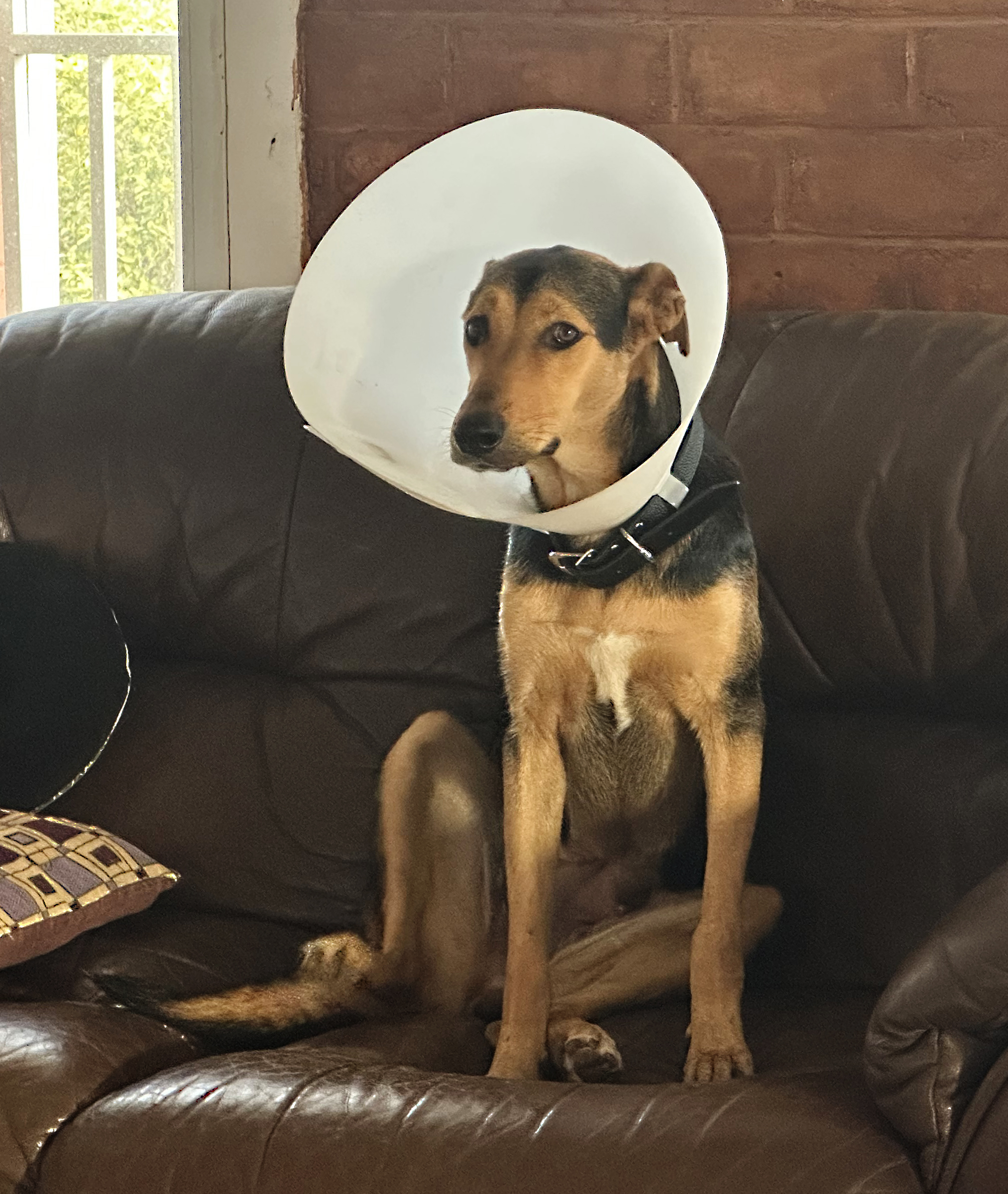
i have an ethical dilemma: is it right to do this to a dog?
many say it's normal, common practice, no need for a second thought.
the dilemma revolves around a few points:
animal welfare — spaying can prevent health problems, reduce risk of infection and cancer.
agency and natural behaviour — it alters a dog's natural life course. dogs can't consent, so we make a choice on their behalf.
human responsibility — as her caregiver, my decisions carry consequences. often, "common practice" arises from balancing practicalities (population control, safety, disease) against the individual dog's experience.
i look at her and feel the weight of the decision. i limited her, i altered her, i took away a piece of what might have been.
ethics is rarely clear. most people rely on what is customary, on what society normalised. so did i.
people told me it is ok that i did it and i was relieved. but the truth is i did it for my own peace. in chosing for her i must carry the knowledge of what is lost even as i hope for what is preserved.
Wednesday, 1
Art Space Work of the Month
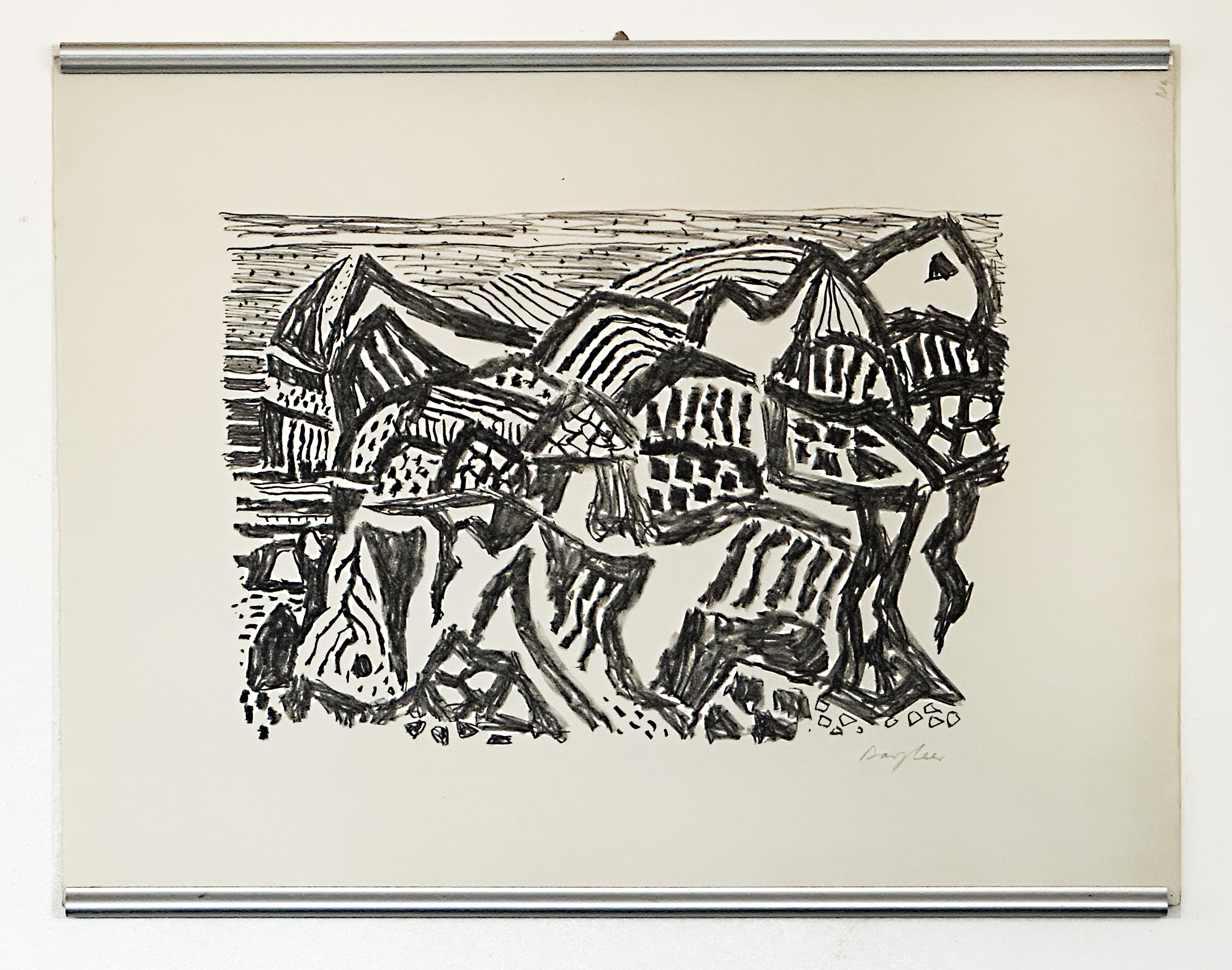
Eduard Bargheer (1923-2005), Auf Ischia (on Ischia), lithography, 1965, 49 x 63 cm