Tuesday, 31
i hate myself for doing this to her. she was as enthusiastic as ever when we went out. she followed me with such complete trust, without any hesitation, wherever we would go.
most of the people i talked about recommended it: she'll be calmer, no more mating season, no more male dogs chasing her. they said it like it's obvious, like it's care.
maybe it is. some held back with their opinion, saying it was up to me. but nobody told me not to do it.
something will be missing, though. i know that from my two other dogs, who were neutered. some weeks ago Beenie stood next to Saw and sniffed her. he looked at me in a way i couldn't quite ignore. as if asking or even reproaching why did you do that me? that time i was still in the process of thinking about the spaying, tried to postpone as much as possible.
this morning, when i left her there, unconscious, i still wasn't sure. i'm still not. but i went anyway. as if being guided by something that had already taken hold.
on the way to the vet we passed the street dogs, moving as they wanted, stopping, sniffing, following whatever pulled them. free in a way she will never be.
on the way back, not far from my home, i passed Barra, the man where i regularly get my Cafe Touba, where people occasionly hang out. they had seen me earlier with Saw. now, when i passed without her, they asked, where the dog was. i told them. they said: people here don't do it.
Monday, 30
yesterday i met a woman with whom i spent some time at Solomon's Beach Bar. the beach was crowded, as it is every sunday, but between us there was a quiet ease — words flowed like water, unforced. her presence carried an intensity, not loud but concentrated. we spoke in german, so i'm translating my recollection.
what stayed with me most was her account of traveling to the canarian island La Palma during the volcanic eruption. she had chosen to set up camp near the volcano, placing herself at the threshold of something immense and uncontrollable. not out of carelessness, but out of a desire to witness, as if drawn towards it, wanting to see it from as close as possible. it was as though the earth speaking, she said — or more precisely, as though it was expelling itself, revealing what is usually kept hidden beneath the surface.
she told me she could feel the seismic waves before the earthquakes arrived — a trembling that passed through the ground and into her body. i tried to imagine that sensation — frightening and intimate, as if one's own rhythms briefly alligned with those of the planet.
the ash, she said, settled everywhere, in thick suffocating layers. people shoveled it away constantly, gathering it to designed places.
and yet, despite or because all of this, she called it her most moving triip of her life. others criticised her exitement reminding her that many people lost their homes.
Sunday, 29
i checked my emails and received wonderful news:
my application for Koyo Kouoh's Biennale Arte Venezia In Minor Keys pre-opening has been accepted. i feel a quiet, radiant joy.
Thursday, 26
in Dream Count, Chimamanda Ngozi Adichie writes from Omelegor's perspective (p. 360) that sadness is "a low-hanging fruit," while hope and happiness require an upward reach. there is something unsettling in this idea — that sadness might be the easier emotion. it reverses the common assumption that happiness is natural and sadness a deviation, something imposed by circumstance.
I say I'm worried about Atasi and I feel I have failed at giving her something she needs. It is easy to be sad; sadness is a low-hanging fruit. Hope and happiness you have to reach higher for and I didn't teach her how.
sadness, in this formulation, appears as an affect of minimal resistance. its immediacy suggests that it is not merely reactive but latent — already inscribed within the subject as a readily available mode of being. to describe sadness as low-hanging is to situate it within a logic of proximity: it is in this sense, effortless — not because it lacks depth, but because it does not require cultivation; it emerges within conditions of passivity.hope, by contrast, introduces a demand. it is articulated through the metaphor of vertical displacement. to reach higher implies effort, intentionality, and a departure from the given. this movement is neither automatic nor guaranteed. it presupposes a capacity to orient oneself towards what is not immediately present. in this sense, hope is not simply an emotional state but a projection — an act that exceeds current conditions and gestures towards futurity. happiness, aligned with this movement, becomes less an outcome than a byproduct of this orientation. it is the effect of having reached at all.
what must be conveyed is not knowledge, but a relation — a way of standing in the world that resists the sufficiency of what is given. such relation cannot be imposed; it can only be made visible. where it is invisible or absent, the given asserts itself as total. sadness then ceases to be one possibility among others and becomes the condition within which all experience is interpreted.
what remains, then, is the recognition of a missed gesture. not a failure to protect from sadness — that would be neither possible nor desirable — but a failure to insist, gently and repeatedly, that it need not be the only ground on which one stands. to have taught hope would have meant encouraging an activity: a turning towards what is not yet given, a practice of reaching beyond the immediate. and perhaps, in that movement, happiness might have appeared — not as something secured, but as something actively made possible.
Tuesday, 24
I didn't have money when I was sixteen and told the popular boy, Obinna, who I liked, that I didn't want to be his girlfriend because I wanted to be free. But Jamila is really saying that money is an armor and she is right. Money is an armor but it is a porous armor.
No, money is an armor and it is a porous amour. It shields you, feeds you the potent drug of independence, grants you time and choices. Because of money I can go where I want and when I want, and this is still heady, and still intoxicates. When I first began to make more than I imagined I would, I would cajole myself to spend, whispering to myself, "I can actually afford this now, I can afford this now."
Chimamanda Ngozi Adichie. Dream Count: A Novel (p. 339). (Function). Kindle Edition.
now, things are different. i am retired, and for the first time, money has become what Adichie describes in her novel as a form of protection.
it allows me not to worry constantly. it gives me choices that once did not exist. i am able to decide what to do with my time. this still feels unreal at moments and i still rectify my Dasein through small acts like household tasks. i still work, but on my own terms. sometimes i catch myself thinking: I can actually afford this now.
this independence is not grand or excessive. it is simple. it is the freedom from anxiety, the ability to solve practical discomforts. if there is only cold water in my house and no cafe in the neighbourhood, i can rent a small apartment in town where there is hot water and a place to go out. this is not luxury to me. it is relief, a small act of care towards myself.
and yet, this is where the armor reveals its porousness.
what feels like relief to me can appear differently to others — i sense hesitation, questions, doubts, something i cannot always name — even among close friends. it hurts, because my instinct is not to separate but to share. i would like others to feel this lightness, this reduction of worry, this quiet independence.
there is something particular with younger friends. they are still in a phase i remember well. sometimes they say they would like to have what i have. sometimes they want me do more, make more, use opportunities so that more money comes in.
but i notice that i do not want that anymore in the same way. i do things when they fit into my life, not when they disturb it. i am older now, and less willing to take risks.
i realise freedom cannot be shared in the same way as a meal or a conversation. it creates differences. it exposes gaps. and those gaps can be felt. so i find myself in a delicate position: grateful for what i have, protective of it, and at the same time saddened that it can create distance. i withdraw a little, not out of pride, but to preserve a way of life that still feels new and not yet entirely secure.
for me, freedom is not for achievement or display. it is for itself. it is the ability to live without constant concern, to move through the day with a certain ease. that is enough.
and perhaps this is what remains unresolved:
the wish that others could understand this freedom, and accept it — not as something that separates, but as something simply lived.
the armor protects me. but it does not protect me from being seen differently.
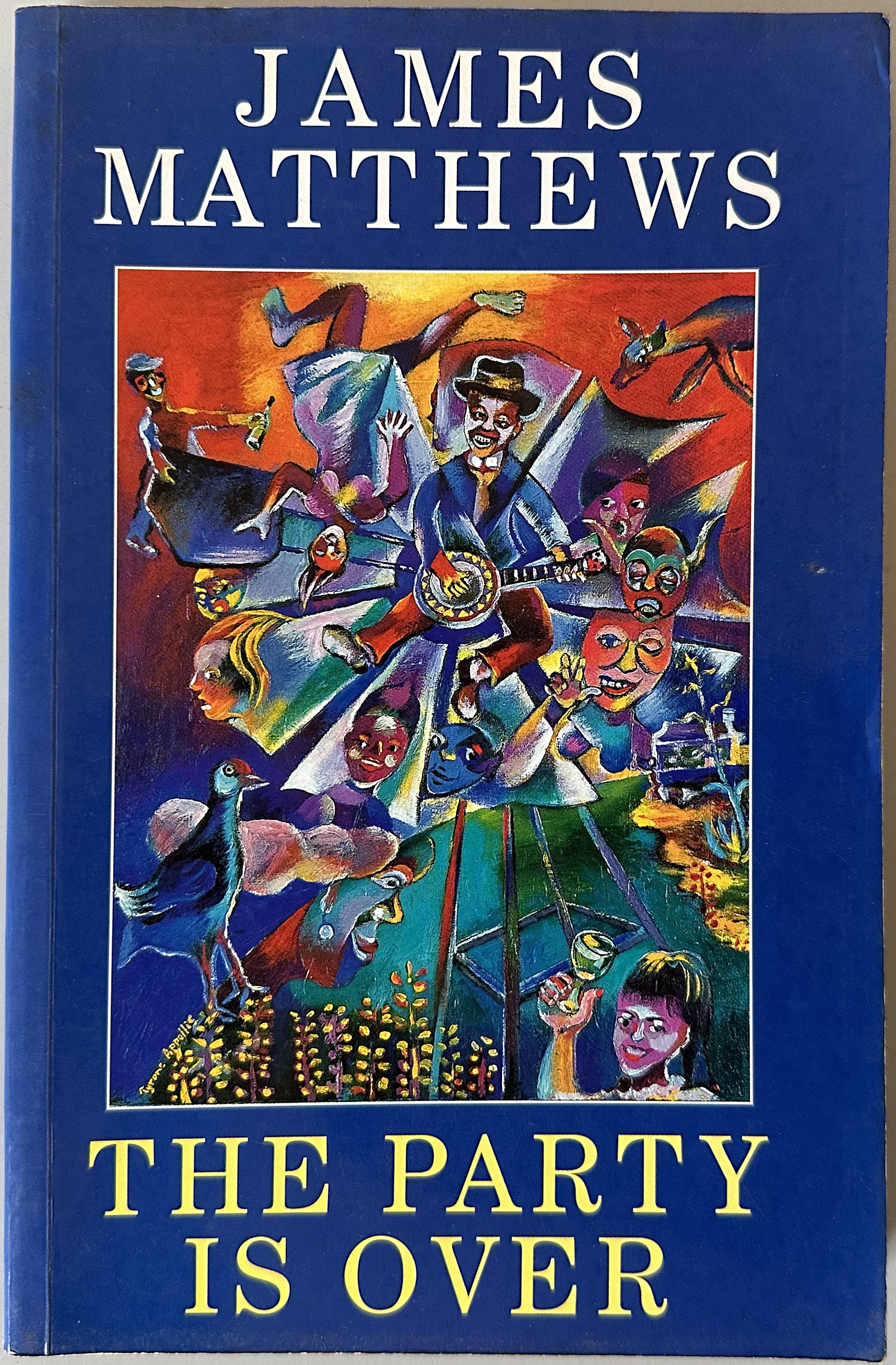
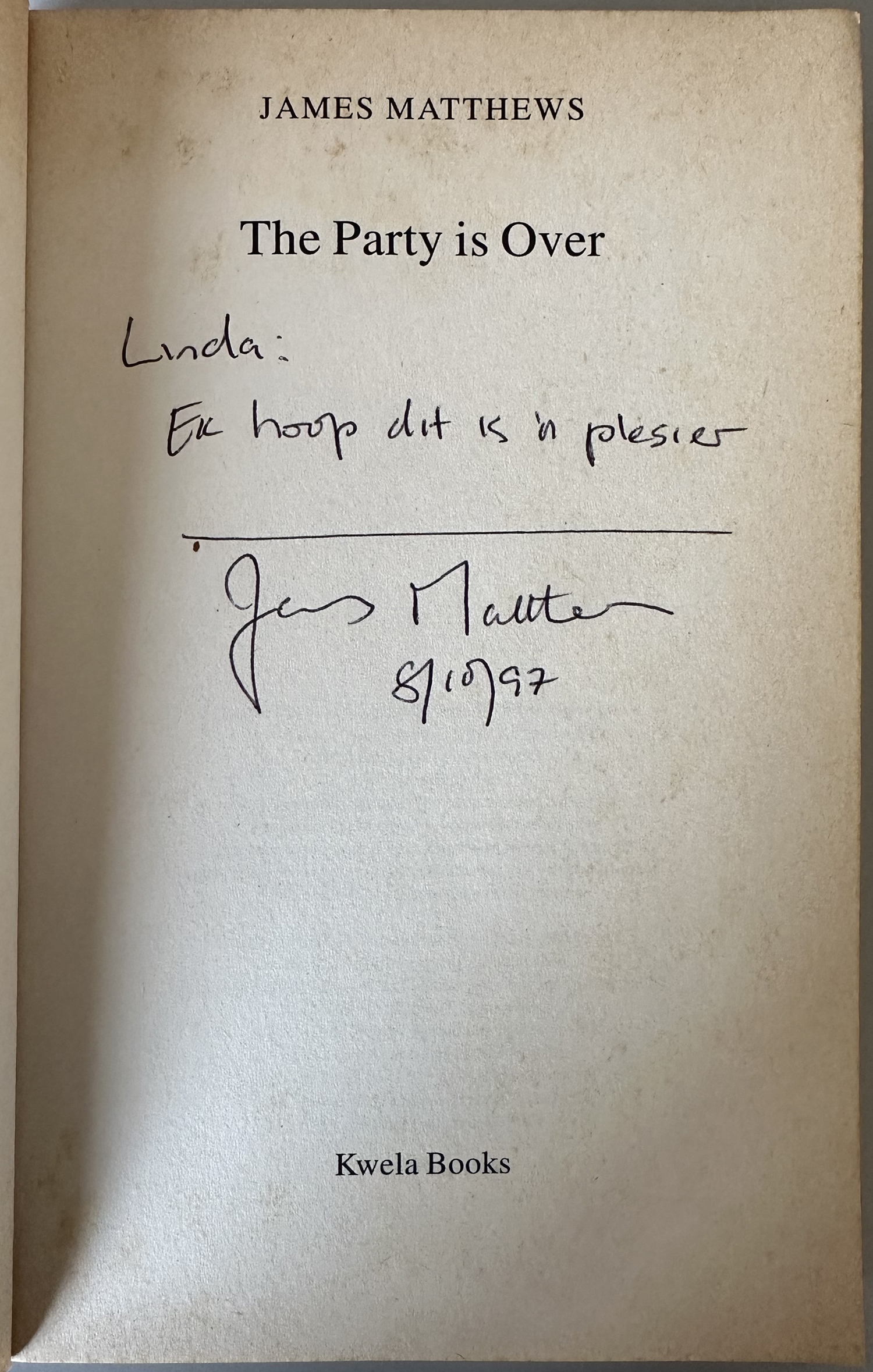
yes, the party's over now — which brings back a memory of a book i read more than twenty years ago: The Party is Over. i remember how much i loved reading it.
our Koriteh celebration was small, maybe fifteen people, but i was genuinely happy to see everyone, even though i hardly had time to sit or talk. i kept moving — opening the gate, showing people around, preparing and checking on the food, etc. no one asked me to do so; i chose that role myself, intuitively.
there was one brief moment when i wanted to sit down at a table and rest. instead of welcoming me, the people there simply handed me their trash. a small sharp feeling of we don't need you. as if i didn't belong there at that very moment.
and yet, when they left they were kind, grateful, warm in their goodbyes. it reminded me how much situations shape behaviour. it wasn't personal — just the rhythm of the gathering, and perhaps also the role i had taken on.
today, when i posted the book at the artspacegroup i found the dedication in it. i bought the book at a second hand bookshop during my residency in Johannesburg. strange how objects can carry time so quickly, linking one moment of life to another.
Wednesday, 18
i am currently on three small formats (3,8,4 pieces) that will be a triptych. the whole has something of a Cubist feel. i am not convinced by my new technique, which somehow does not seem all that new. with a more realistic style of representation, where everything is recognisable and defined, there is no ambiguity about the content. here, in this more immaterial abstract approach, questions remain unanswered. why a particular colour or form, why even this painting? does it make sense?
i notice that this unsettles me. the openness, the lack of clarity, creates a certain insecurity. at the same time, this is the challenge i am looking for: a way to free myself from the feeling of having to control everything. to be able to be surprised by the result, not from the standpoint of admiration, but to recognise that the impact is different from what i intended, and to accept what is there. nevertheless, do i wonder if i will arrive at any empirical findings.
Monday, 16
Ramadan is drawing to a close and we are busy preparing an event for the second day of Koriteh. not much time left to let the thoughts wander or even delve deeper into them.
Saturday, 14
reading this passage, i think of gambians in basel. at the time i was still living in europe and only beginning to have encounters that later would become part of my everyday life.
I had never used that one before—I pray at a particular time at night—but I guessed it would work, as invoking religion invariably does. Just the mention of prayer shuts down all thought.
reading this line in Dream Count by Chimamanda Ngozi Adichie (kindle edition p. 334) a moment from years returned to me. something that had puzzled me at the time became clearer. the passage seems to cast light backwards.it wasn't as if these people i occasionally met prayed at a particular time. rather, sometimes in the middle of a conversation one of them would say: "I want to pray." the sentence arrived without preparation, like an interruption of reality. the athmosphere shifted. a sudden break in what we were doing.
subconsciously i understood somehow. it was a way of changing the situation or the topic without having to say so directly — instead of explaining discomfort, disagreement, or simply the wish to interrupt what was happening.
religion carries a certain authority. once prayer is mentioned, the conversation dissolves. nobody argues with prayer.
Thursday, 12
on the way back from Kololi on tuesday, as we drove past the GRA in Kanifing to pay the vehicle tax, we passed Timbooktoo. i took the opportunity to step in and see if they had Dream Count for the library, but unfortunately it was already sold out.
as i was about to leave, my eyes wandered over the book table by the door and i spotted The Death of the Author. "That's brilliant," i said to Ousman, Katie's husband, who runs the shop with her. he asked if i had heard of it. "No," i replied, "I've read it. I loved reading it." in a quiet voice i added that i had read it on the Kindle. i am aware that for bookstores the age of digital e-readers is not a blessing.
the moment triggered a small chain of memories. Kindle... my parents gave it to me as a gift to mark my graduation from high school (Abitur) when i was nineteen years old.
Kindles Malerei Lexikon.
that's how i got the idea to add this art encyclopedia to the Art Space Library, eventually. i never considered that and put it away in the furthest corner. the volumes are in german and, i assume — i haven't looked at them for ages, only carried them with me through every station in my life, like a reminder — eurocentric, which makes them questionable. i've been on the verge of throwing them away several times. there are many illustrations, though, and someone might find them useful or simply enjoyable to browse through.
while photographing the books, i noticed that it is not Kindle but Kindler. memory seems to edit things in its own way.
Wednesday, 11
living in the countryside feels like existing slightly outside of the rhythm of the world. days can be very full and yet sometimes they also feel oddly invisible. you invest many hours in something and still wonder, if anyone, will ever notice it.
the House of Culture Tintinto comes back to my mind. in the beginning i imagined it as a place of encounter, a space where ideas, art, and conversations could circulate freely. in my mind it was simple: if you build something meaningful, people will eventually come. reality, however, is slower and more uncertain. interest does not appear automatically.
i try to remind myself that many things in life grow quietly. a tree does not rush to prove that it is growing. still, human beings are different. we hope for signs — some reaction, curiosity, a visitor, a question. without these signals, doubt begins to creep in.
for me, myself, energy has become something more precious. tasks that once felt light now require more determination. even so, there is still a certain satisfaction in the act of doing: placing a stone, cutting a branch, feeding the goats and chicken or chasing them into their area, writing a paragraph, drawing or taking a photograph of a moment that might otherwise disappear unnoticed.
perhaps this is enough reason to continue. not because the world necessarily asks for it, but because the doing itself — however small — keeps one in conversation with life.
Tuesday, 10
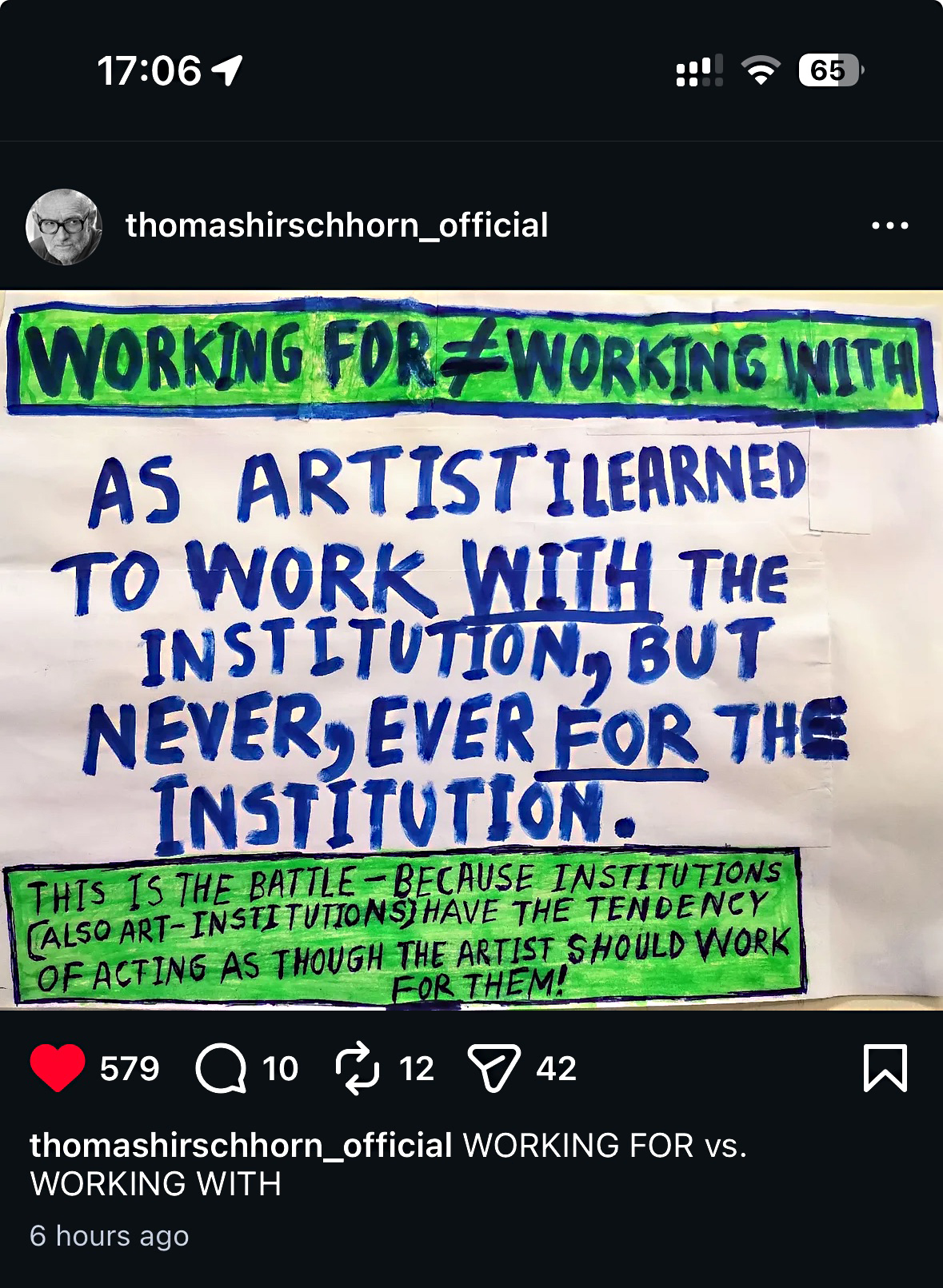
this instagram post by Thomas Hirschhorn just convinced me.
work with the institution, not for it.
Monday, 9
Tahoe is finally uploaded and installed. somehow the computer feels new, and my own data feels unfamiliar. at the moment i am tired of technology, but that's probably just a temporary mood.
Sunday, 8
this morning i was talking to my brother, a successful businessman, about the Venice Biennale and the accreditation for the pre-opening. i explained that i don't expect to receive an invitation. he reacted with surprise and asked why i thought so. Why i shouldn't get an invitation?
for him it seemed obvious that i would.
his reaction made me pause. since he was so convinced, i asked myself why i doubted it so much. i realised that i didn’t have an answer. later i pondered that kind of self-doubt is inherent in our family, which he certainly did not support, but on the contrary, had overcome, judging by his success. perhaps i am simply used to expecting less.
hence my feeling changed, and in that very moment i believed: Yes, probably I will get one.
Friday, 6
"In order to be accredited and receive an invitation to the pre-opening of the Biennale Arte 2026, which will take place at Arsenale and Giardini on 6, 7 and 8 May 2026, professionals (presidents, directors and curators representing cultural institutions) should fill in the online form.
La Biennale di Venezia will take into consideration requests arriving no later than 24 April 2026 and will notify the eligibility in writing.
This form is strictly personal and does not grant entrance to the exhibition venues during the pre-opening.
Deadline for sending the form: 24 April 2026."

i submitted the form twice: once as director of House of Culture Tintinto and once as director of MALOLA, as i represent both of them. i thought it was worth trying at least. however, the art world functions through networks and socially chosen people and circles — something nobody wants to hear and that is rather kept quiet.
still, sending the application felt like a small gesture of insisting on being present.
Thursday, 5
She nodded then shook her head, confused, thinking back on the question, in search of lost meanings, because why did he keep asking if she was sure, when she had told him a few times already that she did not know.
Adichie, Chimamanda Ngozi. Dream Count: A Novel (p. 281). (Function). Kindle Edition.
at chapter eight (p 251), two pages in, the tone of the novel changed. i suddenly found myself confronted with a violent scene, not only shocking in itself but also in the way it broke the reflective atmosphere that had accompanied the book until then. i read much faster, almost flying over the pages, wanting to know what would happen next and hoping to reach some form of resolution — iike in a crime story.
by the time i reached the court scene, i realised how tense the reading had made me. what had begun as a quiet morning with a book had turned into something emotionally much heavier. the story no longer unfolded in the reflective way it had before, describing Kadiatou's life — happy with her work in a hotel, going to cinema with her daughter, supported by Chiamaka. the rape itself, as well as the investigations afterwards, drew me in completely. Kadiatou had difficulty even realising what had happened, unaware of her rights and afraid of losing her job. this was exactly what made me nervous: her vulnerability, her uncertainty, and the feeling that she had almost no space to defend herself. the narrative had become a confrontation with fragility, power and those whose survival depends on others.
reflecting on the experience, i realise how differently literature can affect me. some books make me pause and think, linger on ideas, and encourage me to quote them. Dream Count however hit me like a film: immersive, immediate, inescapable. the confrontation with human fragility, injustice, and resiliance in this vividly realistic novel touched me in a way i did not expect. drawn into the violence, i was steamrolled by the narrative and unable to distance myself. i had to stop. but now hours later, i find myself strangely eager to continue reading and see what will happen at court.
--------------------
while busy on our cleaning day, i still managed to sit down at my laptop for moments to jot down ideas for the post above. at some point, though, i closed it shut, only to later realise that i had interrupted the download and had to restart it again from scratch. 24 hours of download time, 8 GB of data – all for nothing. oh well, i'll do it in town then.
Wednesday, 4
today i finally started updating to Tahoe. not on this laptop — the one i use to write and update my diary — but on the newer one from 2021. this laptop is from 2014, and an update would stop the programs i depend on from working.
the process is slow, very slow. i thought about doing it when i was in Hamburg, but for some reason
didn't. here, though, the process crawls and i read it may take up to five days to complete.
however, somehow i feel glad. by updating it here, it becomes part of this place.
Tuesday, 3
the fair is already over, but i personally don't care. this is my diary, not an art magazine. therefore, i write about whatever crosses my path.
german version
contemporary art fairs occupy a complex position at the intersection of aesthetics, commerce, and politics. they are spaces where artworks are not only exhibited but also strategically presented, shaping perception and signaling cultural power. understanding these dynamics requires examining both the institutional frameworks that govern visibility and the individuals who mediate them. Jörg Heiser's text offers a perspective on these tensions, while curator and artist Wael Shawky has grappled with the challenges of maintaining artistic integrity in such staged environment.
in his article On Art Basel Qatar, published on e-flux, Heiser examines the art fair as an instrument of state image management. he situates the fair within a network of power, visibility, and investment, emphasising that such global art events are closely intertwined with political strategy and soft power. in this context, art functions not only as a commodity but also as a symbol — a vehicle for projecting national identity, cultural sophistication, and strategic influence.
a central point in Heiser's analysis is the way visibility is curated and staged. he explaines that artworks are exhibited based on social and political narratives they convey. the fair, he argues, transformes artistic production into a performative instrument of diplomacy and statecraft, thereby illustrating how institutions shape perception and assign values.
Wael Shawky, the fair's curator, on the other hand, sought to reconcile the pressures of institutional spectacle with his sensitivity to artistic intention, in the interest of the artists. Shawky's curatorship priorised the artist's agency while simultanously addressing the constraints of visibility and expectation that Heiser criticises. in doing so, Shawky demonstrates how careful curatorial practice can preserve the integrity of artistic expression even in highly mediated and politically charged frameworks.
this tension between structural forces and individual agency is central to understanding contemporary art. Heiser's critique underscores how global art events function as instruments of power and diplomacy, while Shawky's work illustrates how thoughtful curation creates space for meaning, nuance, and genuine engagement with art itself. together, their perspectives reveal both the limitations and the possibilities inherent in contemporary art production and presentation.
addendum: i encountered Jörg Heiser quite by chance: i added him on facebook as a friend after mistakenly thinking he was Aphex Twin, because he used the Windowlicker cover as his profile picture. this eventually led me to discover his writing.
--------------------------
a brief note on why my featured works of the month almost exclusively come from the Griffelkunst collection, which my parents bequeathed to me. the simple answer is: i have no better resources, much to my own regret. the collection is a treasure trove, and i am grateful for it. before presenting any piece, i take time to research it. most of the artists are relatively unknown, many already dead.
of course, i would rather present works by local artists. i would love for the feature to grow organically out of the place where i live now. but the truth is: i hardly meet any artists at all. that's my reality. and even if i did, i wouldn't just choose a work solely because it's local. other factors must align — the quality, the resonance, etc.
sometimes friends tell me about artists they know. when i ask for introduction, nothing follows. i have learned not to linger in that space of waiting. to avoid to get stuck in disappointment, i work with what is at hand.
in the end, i am most interested in the image itself — if it fits into the surroundings, whether there's a dialogue with what is here. this month, for instance, i connected the selected work with the fishing boats along the shore, mostly operated by Senegalese fisherman in this region. the dialogue between image and environment matters more to me than origin.
and yes, i still dream of sculptures in the garden.
Monday, 2
spring vibes are continuing

Sunday, 1
Art Space Work of the Month
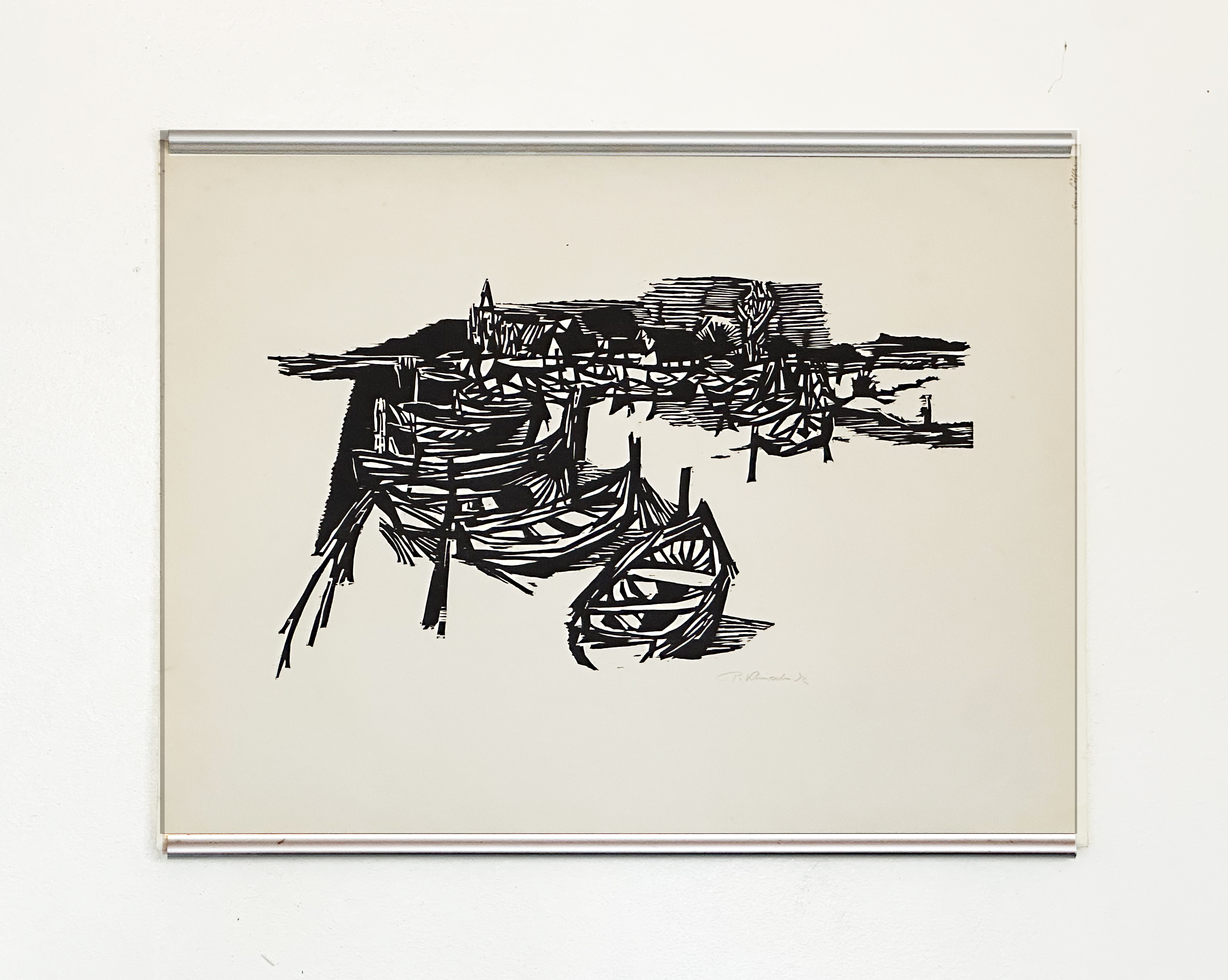
Peter Kleinschmidt (1923-2005), Bucht mit Booten (bay with boats), woodcut, 1959, 28,3 x 48,5 cm